
























































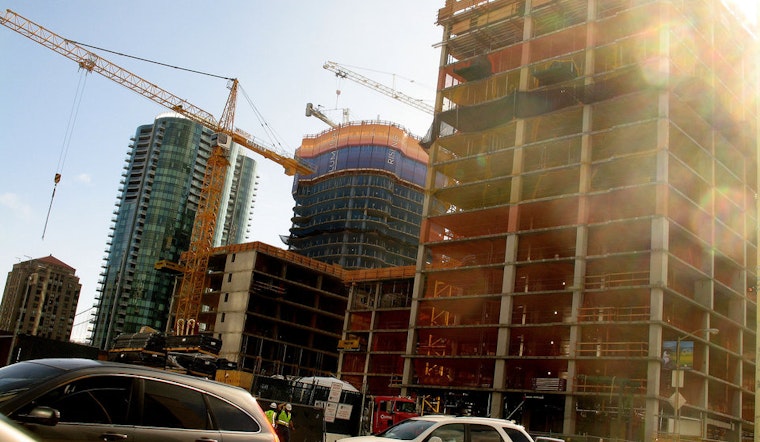
Yesterday, San Francisco's Board of Supervisors unanimously approved amendments to a proposed law aimed at increasing the percentage of below market rate (BMR) housing included in new developments.
"This is a major step today towards a more livable and diverse San Francisco for all income levels," said Board President London Breed in a statement.
"It’s no secret that San Francisco has one of the highest housing costs in the nation, and as a result, we have a severe shortage of housing available to a wide array of very low, low, moderate and middle-income residents," Breed continued. "It is time our affordable housing policies reflect true diversity in income levels."
The amended ordinance is part of the city's Inclusionary Housing Program that requires developers who create 10 or more units to either pay an Affordable Housing Fee or set aside a portion of BMR units for low- and middle-income residents.
The changes by the Board amend Proposition C, which increased requirements for affordable housing on developments with 25 or more units and was approved by voters in June 2016.
Fighting for real housing opportunities for real San Franciscans! So proud we are passing new law today to keep workers living in our City! pic.twitter.com/WaOrqFcN7m
— London Breed (@LondonBreed) July 11, 2017
Breed, the lead sponsor of the legislation, praised what she called a "consensus agreement to achieve a new standard for affordable inclusionary housing in San Francisco." Supervisors Aaron Peskin, Jane Kim, Ahsha Safai, and Katy Tang were also listed as sponsors of the legislation.
Safai issued an amendment that would require any project with more than 10 units to set aside at least 25% for two and three bedrooms, and 10% for three-bedroom units. A developer could, however, apply for conditional use authorization if there was a hardship, "but would have to make a compelling argument," Safai said.
Exemptions to the amendment would include buildings that are 100% affordable, student housing, single room occupancy hotels (SROs), and group housing.
Safai said the law would not impact development in land use areas such as in the eastern neighborhoods or with Home-SF, which receives a density bonus and would have to reserve 40% of a project's inventory as two- and three-bedroom units.
Thank you to my colleagues on the entire Board of Supes for unanimously passing today's inclusionary housing legislation! #housingforall pic.twitter.com/mEHLaLJN5y
— Ahsha Safai (@Ahsha_Safai) July 12, 2017
Supervisor Kim introduced an amendment that changed the law to include studio units, but only if applicants meet minimum occupancy requirements, or two people share a studio.
Kim said two people earning 130% of the city's area median income—roughly $120,000/year—better resembled middle-income earners who would qualify for BMR.
"The idea is that two people making 130% median income would be more in alignment with middle income housing as opposed to one person making the same amount," she said.
The meeting was held up several times as supervisors sussed out details and finalized language to the amendment proposed by Kim.
Peskin said his office was awaiting one final amendment from the Office of Community Investment and Infrastructure, "which is not ready today but will figure out next week."





