

























































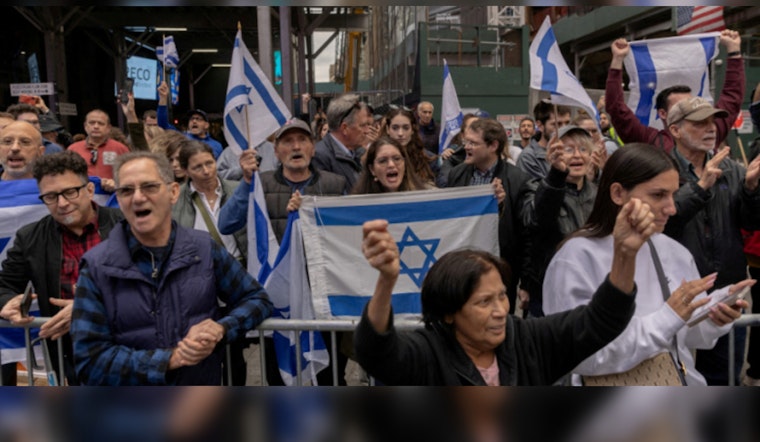
Earlier this week, 106 demonstrators demanding an end to the Israel-Hamas war were taken into custody at a protest at the Ogilvie Transportation Center in downtown Chicago. Meanwhile, hundreds of Chicagoans joined the March for Israel in Washington, D.C., to show solidarity with Israel and speak out against the recent uptick in antisemitism according to ABC7.
Jewish participants in the Chicago protest, hailing from cities such as Milwaukee, Kansas City, and Indianapolis, were calling for a ceasefire to help reduce violence in Gaza. Simultaneously, approximately 60,000 people were estimated at the March for Israel in Washington, D.C., voicing their support for the Israeli people and advocating for the freeing of remaining hostages as reported by NBC Chicago.
Those protesting in Chicago expressed their support for ending the Palestinian's suffering, arguing that the principles of their Jewish faith demand freedom, safety, and justice for every person, including Palestinians. Those at the March for Israel, however, expressed their concern over increasing antisemitic incidents and remarks, fearing for their loved ones and the Jewish community.
Among those arrested at the Chicago protest was Jesse Sharkey, former president of the Chicago Teachers Union (CTU), and CTU's vice president Jackson Potter expressed condemnation of Israel's bombing of Gaza. A planned participant in the March for Israel was Nate Lichtenstein, a child of Holocaust survivors, who relayed his disbelief and worry about the rise in antisemitism as per NBC Chicago.
Considering these protests, it is necessary to note that the pursuit of justice can be a matter of perspective. The Chicago protest aimed at promoting a ceasefire and freedom for Palestinians, under the belief of justice for all. Concurrently, the March for Israel stressed the need to confront mounting antisemitism and the significance of maintaining solidarity with the Israeli people.
Renewing attempts to understand from polarized perspectives may play a key role in a peaceful resolution of this protracted conflict. Tackling issues of injustice from both sides presents distinct viewpoints, be it the treatment of Palestinians or the spread of antisemitism. With these contrasting views, discussion on the Israel-Hamas war and the broader Israel-Palestine conflict should be approached while listening closely and striving for common ground that can bridge geographical and ideological divisions.



