

























































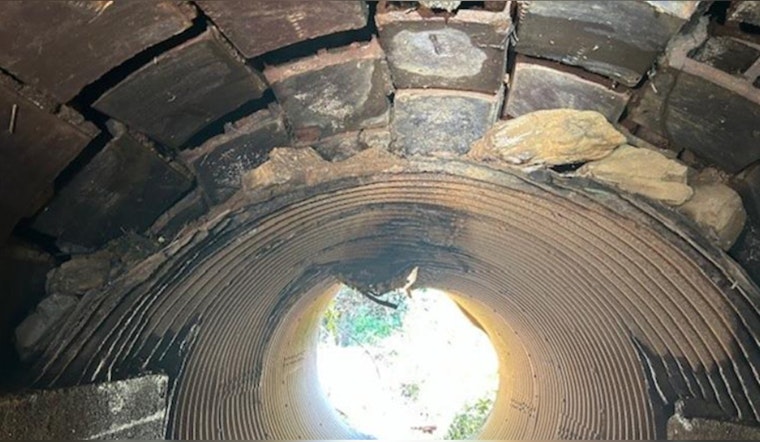
A routine inspection of a culvert scheduled for replacement this summer on N.C. 200 in the Bost Mill Historic District of Cabarrus County uncovered a remarkable piece of construction history. According to the North Carolina Department of Transportation (NCDOT), the centuries-old structure revealed a diverse array of materials, including cut granite, arched terra-cotta blocks, and modern corrugated metal pipe. Notably, the corrugated metal pipe, despite being the most recent addition, was found to be in the worst condition.
Robert Plyler, bridge maintenance engineer for the NCDOT, immediately recognized the structure's uniqueness and its place in local heritage. "The original structure is terra-cotta glazed tiles, which is a unique structure," Plyler told NCDOT. “This one also has a granite extension, so hand-split granite rocks were added in order to widen (N.C.) 200. We knew it was almost this wide in 1937."
Further analysis by the NCDOT's Environmental Analysis Unit confirmed the culvert as a rare example of early 20th-century construction technique that employed hollow structural masonry block, a specialty of the Pomona Terra-Cotta Company. The discovery became part of an ongoing investigation by NCDOT archaeologists and architectural historians into such culverts, which has identified only eight examples so far. Although safety and functionality requirements make preservation in situ impossible, teams have undertaken extensive documentation to ensure these structures are remembered in the state's archaeological and architectural record. Representative tile blocks have been retained at the Office of State Archaeology's Research Center in Raleigh for further study and comparison.
In a nod to incorporating historical elements into modern infrastructure, the NCDOT is repurposing the granite for the construction of a new headwall. Designed to add a touch of history to the modern replacement structure, "We're going to recycle material that's at least 100 years old into this modern structure so that adds more of a construction aspect, as opposed to a typical pipe replacement," Plyler explained in an interview with NCDOT. The preserved granite will facilitate the construction of a 25-foot long and 10-foot-tall headwall.
The project stands out as a singular opportunity for the NCDOT team, capturing the essence of historical preservation in the field of civil engineering. "It's a once-in-a-lifetime DOT chance due to the size of this structure," Plyler said, indicating the rarity of encountering such significant historical structures.




