

























































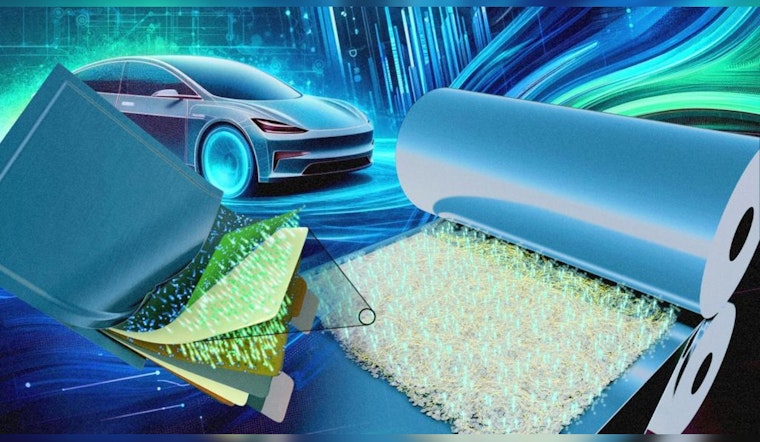
In a significant leap forward for the realm of electric vehicles, a team spearheaded by the Department of Energy's Oak Ridge National Laboratory (ORNL) harnesses the properties of polymer binders to create a new breed of sulfide solid-state electrolyte membranes, as reported by ORNL's news release. These membranes, touted for their remarkable elasticity and strength, are pivotal to the development of solid-state batteries, which are expected to outshine their liquid electrolyte counterparts in both safety and energy density.
According to Guang Yang from ORNL, the team's findings have the potential to "at least double energy storage to 500 watt-hours per kilogram," addressing the pressing need for electric vehicles and electronic devices that sustain longer periods between charges this innovation lies in the ability to construct solid-state electrolyte membranes that are no more than 30 micrometers thick, promising to pack a greater energy capacity within a limited space and achievement outlined in the journal ACS Energy Letters. Sulfide solid-state electrolytes, boasting ionic conductivity on a par with existing liquid options, provide a tantalizing glimpse into a landscape of safer, more efficient energy storage solutions.
Delving into the intricacies of the polymer binder's role, the research underscores the importance of molecular weight for crafting solid electrolytic films of sufficient durability. Yang explained that lightweight binders, despite their lower polymer chain length, lack the robustness required for sustained contact with the electrolytic material, whereas their heavier equivalents endow the films with much-needed structural integrity. Moreover, Yang added that since the polymer binder does not conduct ions, minimizing its use is critical, albeit with caution to maintain the film's quality and enhance ion conduction.
The multifaceted research initiative also involved noteworthy contributions from other experts. Jagjit Nanda of the SLAC Stanford Battery Center and Battelle Distinguished Inventor worked in collaboration with Yang, while recent Florida A&M University-Florida State University College of Engineering graduate Anna Mills applied her nanomaterial synthesis acumen in testing the thin film's electrochemical aspects at ORNL's Center for Nanophase Materials Sciences, key microscope and spectroscopic methods were deployed to assess the film's elemental composition and structure crucial attributes that enable the fine-tuning of the electrolyte's ion conduction and stability, as per Yang's account. To compound their findings, the researchers are outfitting their extensive ORNL lab space with low-humidity environments designed to curb potential contamination when handling sulfides, with eight glove boxes presently designated for this specialized work.



