

























































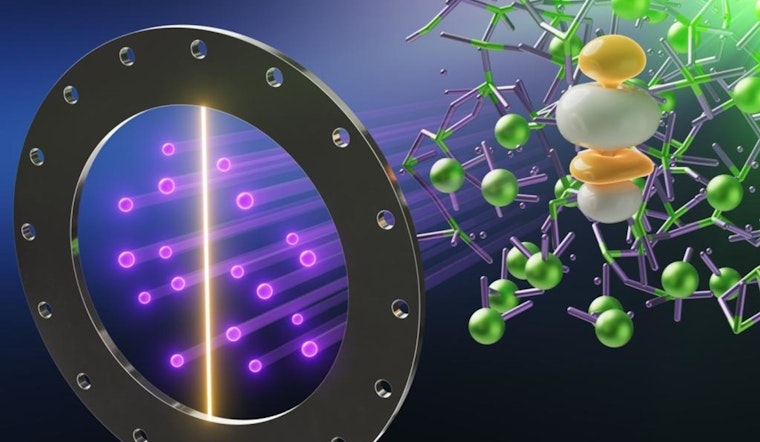
Scientists at the Department of Energy's Oak Ridge National Laboratory (ORNL) are making strides in the understanding of liquid uranium trichloride (UCl3), a potential fuel for next-generation nuclear reactors that could provide a cleaner energy future. In research published in the Journal of the American Chemical Society, the team documented how the behavior of molten UCl3 breaks with conventional expectations, an outcome that could influence the design of molten salt reactors.
Santanu Roy of ORNL, co-leader of the study, pointed out the significance of their findings for practical applications, "This is a first critical step in enabling good predictive models for the design of future reactors" and emphasized that accurate prediction of microscopic behaviors is central to any reliable reactor design. Delving into the chemistry dynamics and structure of high-temperature UCl3, the researchers orchestrated a series of experiments that illuminated the unusual pattern that the substance does not expand; as a rule, heat typically leads to expansion, but instead, the bond lengths within the molten UCl3 actually contracted.
Molten salt reactors, boasting a history of successful prototyping at ORNL in the 1960s, have increasingly captured the attention of the global scientific community in recent years. Understanding the unique liquid fuel salts, which operate in stark contrast to traditional reactors that use solid uranium dioxide pellets, is crucial for this reactor technology. The recent ORNL studies shed light on the unpredictable ion-ion coordination chemistry at play within these substances, composed of the complicated actinide series of elements, to which uranium belongs, requiring high-temperature conditions that mirror volcanic lava to reach a molten state.
The collaborative effort brought together expertise from ORNL, Argonne National Laboratory, and the University of South Carolina utilizing the Spallation Neutron Source (SNS) at ORNL, one of the brightest neutron sources in the world; scientists at this facility are accustomed to dissecting the intricate properties of materials ranging from superconductors to proteins, but studying a radioactive salt at 900 degrees Celsius was an exceptional task that required careful precaution and specialized containment. The SNS facilitated observation of the bonding lengths and dynamics of UCl3 as it transitioned to its liquid form, adding a new dimension to our understanding of actinide chemistry, Alex Ivanov, also a co-leader of the study, expressed astonishment at the findings. "I've been studying actinides and uranium since I joined ORNL as a postdoc, but I never expected that we could go to the molten state and find fascinating chemistry," he said.
Such insights into the intricate behaviors of UCl3, which demonstrate bonds of varying lengths that oscillate rapidly between shorter and longer states, are invaluable for refining both experimental and computational methodologies pertaining to reactor design. The implications extend beyond energy production, potentially proving useful in confronting challenges associated with nuclear waste and pyroprocessing. The research is part of DOE’s Molten Salts in Extreme Environments Energy Frontier Research Center (MSEE EFRC), led by Brookhaven National Laboratory, and utilized additional resources from Lawrence Berkeley National Laboratory’s National Energy Research Scientific Computing Center and Argonne National Laboratory’s Advanced Photon Source, as well as ORNL’s Compute and Data Environment for Science (CADES).



