

























































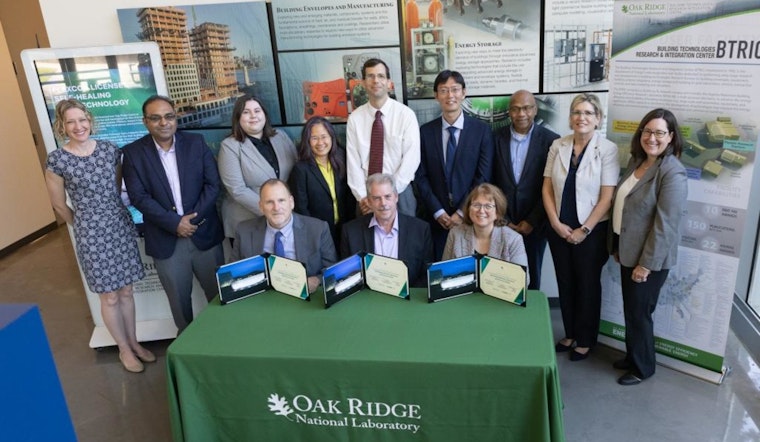
Innovation in the building materials sector takes a significant leap forward as Massachusetts-based Flexcon Global secures the exclusive rights to manufacture a new type of self-healing barrier film, thanks to a partnership with the Department of Energy’s Oak Ridge National Laboratory (ORNL). This development promises to directly impact the energy efficiency of buildings, particularly during retrofitting, by integrating the film into vacuum insulation panels (VIPs).
The collaborative research efforts between Flexcon and ORNL began in 2021, with both entities seeking to fully explore and subsequently enhance the properties of this groundbreaking technology. Unfortunately, VIPs, known for their exceptionally low thermal conductivity, have historically been prone to damage during transit and installation, threatening their insulating performance. The licensed inventions aim to boldly mitigate this flaw, facilitating a more reliable product lifespan and installation process by enabling the panels to automatically self-heal when damaged.
This technology, heralded as a mutually beneficial endeavor, has its roots in a cooperative research and development agreement. "Working with Tomonori Saito and his team has been an exciting opportunity to create a solution for an unmet need in the market. Our relationship with ORNL as a manufacturing developmental partner has been mutually beneficial," Mike Merwin, Flexcon’s director of technology solutions, said in a statement obtained by ORNL News.
The capability of this barrier film to heal itself is rooted in the roll-to-roll coating process that the technology employs. This involves coating a separator substrate with layers of a curing agent and a curable resin to create a film that maintains its insulating properties even when punctured. It typifies how innovation can seamlessly bridge the gap between a product's design and its practical deployment within the built environment. Upon damage, "the curing agent penetrates the separator because of a pressure difference and reacts with the curable resin, sealing any cuts or punctures," researcher Tomonori Saito elucidated in ORNL's overview of the film's properties.
Moreover, the self-healing film's potential extends beyond merely enhancing the life span of insulation materials. The technology could revolutionize multiple market segments, including storage, packaging, food, and pharmaceutical applications. It is notably promising for its adaptability in being integrated into existing roll-to-roll manufacturing systems, enabling scalability and cost-efficiency.
The project signifies an important stride towards meeting decarbonization goals within the building sector, reducing the carbon footprint significantly by offering a solution that responds dynamically to physical disruptions. The CRADA project that facilitated this technology was sponsored by DOE's Building Technologies Office as part of a 2020 Technology Commercialization Fund award. Team members from Flexcon, including Yudi Sahoo, Amanda Young, Chris Kowalczyk, and Julie Beaudry, played integral roles in the research and development initiative.
For further details and potential licensing opportunities related to the self-healing film and other technologies, the public and interested parties can visit the materials portfolio website and the energy and utilities portfolio, as maintained by ORNL. UT-Battelle manages ORNL, operating under the DOE's Office of Science which champions substantial efforts in addressing some of the most pressing contemporary challenges through scientific innovation.



