

























































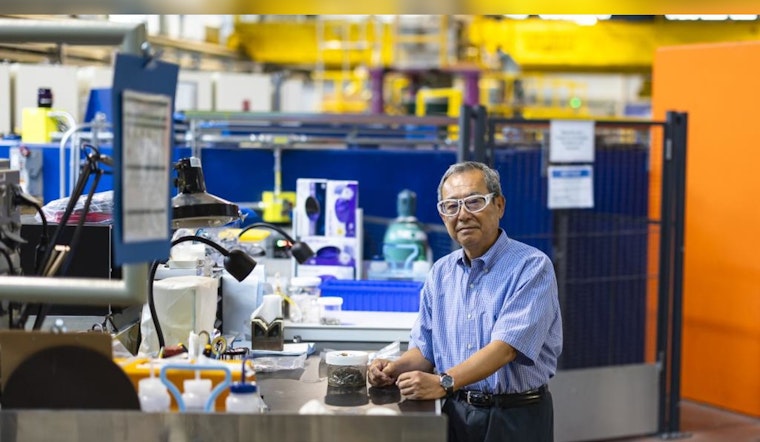
Breaking away from traditional perspectives on atomic structures, Takeshi Egami, a respected materials scientist at the Department of Energy’s Oak Ridge National Laboratory (ORNL) and the University of Tennessee, Knoxville (UTK), has spent his career probing the depth of liquids and metallic glasses. Egami's work brings a fresh understanding to the chaotic atomic world of noncrystalline materials, according to a recent report by ORNL.
Despite the initial skepticism faced by his theories, Egami is no stranger to the long journey of scientific acceptance. His decades-long research has led to the discovery of structures and behaviors in materials that challenge the current theories. The atomic landscape of noncrystalline materials such as metallic glass is disorganized, likened by Egami to "tapioca pearls in a freshly shaken boba tea," a quote from the ORNL article.
Through the use of advanced techniques like neutron scattering and synchrotron X-rays, Egami and his team are shedding light on the mysterious behaviors of these materials. They are exploring, with increasing clarity, the dynamics, structural transitions, and deformations that could pave the way for new applications. Egami's findings are not just academic but have practical implications, particularly for metallic glass, which is widely used in products ranging from medical devices to smartphones.
Egami has challenged the traditional, bottom-up approach to atomic modeling, favoring a wider perspective that takes into account medium-range order. This approach depicts the correlation between a single atom and its surroundings up to a distance of ten times the atomic size. His 2022 paper, co-authored with Chae Woo Ryu from UTK, describes this novel view—calling into question previously dismissed experimental data as mere noise. Reflecting on the broader implications of his work, Egami told ORNL, "Sometimes the conflict can create something totally new."
The scientist's journey toward this new density wave theory and his quest to understand electron behaviors in complex systems are taking him on a one-man talking tour to foster greater acceptance of his discoveries. His perseverance is reflected in his previous work; as Egami noted with a hint of satisfaction, "It's not my first rodeo," referencing his co-authored book that eventually became a standard in the field after a decade of skepticism. He remains patient, yet optimistic, that his recent theories will gain traction in less time than it took Galileo's heliocentric model to become accepted, as detailed by ORNL.
In addition to ORNL's in-house resources, Egami's research is backed by the DOE Office of Basic Energy Sciences. The Spallation Neutron Source, a DOE Office of Science user facility at ORNL, has been crucial in carrying out experiments that support his latest work. This research is part of a larger mission, managed by UT-Battelle for DOE’s Office of Science, which focuses on addressing pressing scientific challenges and advancing knowledge in the physical sciences.



