

























































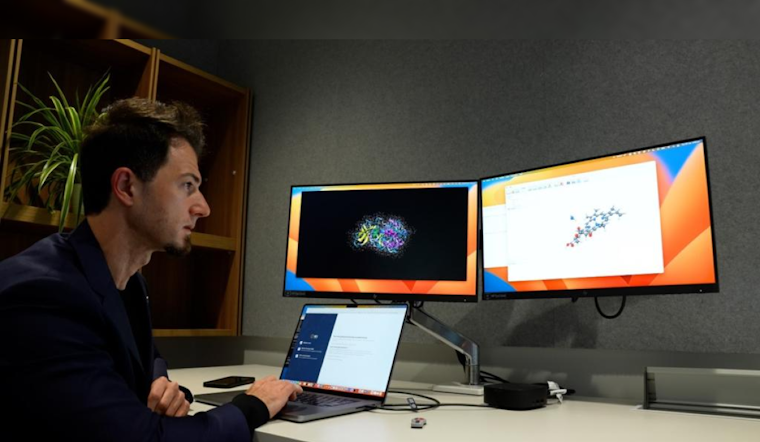
In a significant stride for computational chemistry, an international team including the University of Melbourne and Oak Ridge National Laboratory (ORNL) has been nominated for the prestigious Gordon Bell Prize. Having utilized Frontier, the world's top supercomputer, the group achieved groundbreaking quantum molecular dynamics simulations, a feat recognized for its potential to markedly advance scientific research and drug discovery. The Association for Computing Machinery’s Gordon Bell Prize highlights exceptional achievements in high-performance computing, an award that acknowledges trailblazers in the field.
Accomplished with the collaboration of experts from AMD, QDX, and ORNL's Department of Energy lab, the researchers successfully conducted calculations of a system brimming with over two million correlated electrons. As reported by the Oak Ridge National Laboratory, their laudable efforts traverse a boundary previously not breached, attempting simulations 1,000 times larger and faster than those before. The winners of this esteemed recognition will be announced at the 2024 Supercomputing Conference set for November in Atlanta, Georgia.
Navigating the high seas of scientific innovation, lead researcher Giuseppe Barca, an associate professor at the University of Melbourne, expressed his team's drive to persist in advancing computational machinery and scientific discovery. “It’s an honor to work with such an amazing team of experts and be recognized for this achievement," Barca stated. “We intend to continue building on this new level of sophistication and keep pushing the limits of scientific computing.”
This groundbreaking work was carried out on the HPE-Cray EX Frontier supercomputer and has raised the benchmark for scientific calculations by exceeding an exaflop—marking more than a quintillion calculations per second—employing double-precision arithmetic for utmost accuracy. Dmytro Bykov, ORNL's group leader in computing for chemistry, accentuated the pivotal nature of this development by stating, "Being able to accurately predict the behavior and model the properties of atoms either in larger molecular systems or with more fidelity is fundamentally important for developing new, more advanced technologies, including improved drug therapeutics, medical materials and biofuels." Encased in the facility in Oak Ridge, Frontier astounds with over 9,400 nodes across more than 8 million processing cores fueled by a blend of AMD CPUs and GPUs.
Exemplified by the success of their simulations, the research team's algorithm allowed them to analyze proteins and organic molecules of immense scales, with time steps for some processes minimized to just a few seconds. Bykov praised the accomplishment, recognizing the complexity of deploying a system enlisting more than 37,000 GPUs, saying, "The solution meant using more computing components, and any time you add more, it also means there’s a greater chance that one of those parts is going to break at some point. The fact that we used the entire system is incredible, and it was remarkably efficient.” Support for this breakthrough came from the DOE Office of Science’s Advanced Scientific Computing Research program.
Fueling the forward momentum of both science and high-performance computing, the commendable efforts of Barca and his team underpin the foundational shift in how researchers may now approach the simulation of complex molecular systems. This paves the way for technological innovations and, perhaps most vitally, the development of novel, life-saving drugs.



