

























































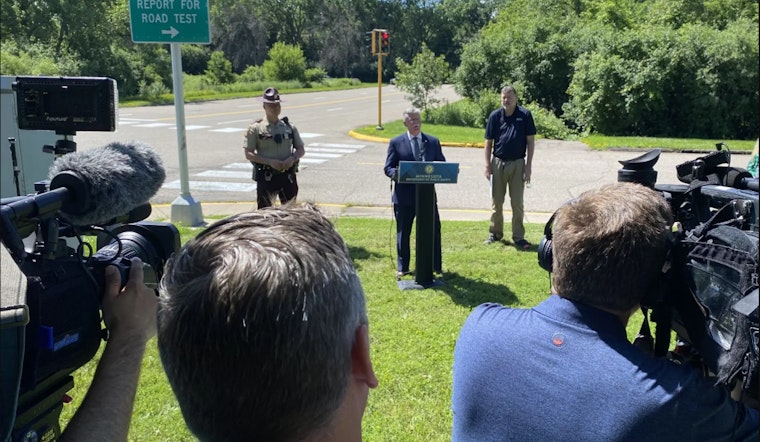
As of July 1, Minnesotan motorcyclists have new rules to abide by – they can now legally split lanes and filter through traffic on state roads. This change comes after the Legislature passed a law in 2024, introducing the concept of motorcycles sharing lanes with cars, a maneuver that’s been met with both anticipation and caution. The Department of Public Safety’s Office of Traffic Safety (OTS) and the Minnesota Motorcycle Safety Center (MMSC) are advising everyone on the road to brush up on the nuances of the new legislation.
"This is a new concept for a lot of Minnesotans. Drivers and riders need to be respectful and remember our roads are shared by all of us," OTS Director Mike Hanson said in a statement. With the law now in effect, motorcyclists are allowed to quickly take advantage to pass vehicles in slow-moving traffic, so long as they don't exceed 25 mph, and they're not going over 15 mph faster than the traffic they're weaving through. Once the traffic regains pace, reaching 25 mph, it's back into their own lane for the motorcyclists.
Filtering is a bit different – it lets motorcyclists move through traffic when it's stopped, say at a stoplight, or stymied in a gnarly traffic jam. But even here, they’re capped at a speed of 15 mph while they filter towards the front of the line. In both lane splitting and filtering, though, it’s a no-go in certain areas, like roundabouts, school zones, freeway on-ramps, and single-lane work zones. "Keeping our roads safe is our priority," MMSC motorcycle safety administrator Jay Bock stated, reinforcing the optional nature of these maneuvers and the importance of sound judgment.
The rollout of this new practice will undeniably require cooperation. Minnesota's OTS and MMSC are counting on drivers and riders alike to stay alert and to exercise patience as everyone gets used to sharing the road in this new way. Motorists should be ready to see more motorcyclists sliding alongside them and need to know not to block their path, although they're not required to actively make room for them, either. "This is a big change for Minnesota’s roads," Bock noted, emphasizing the shared responsibility to foster a climate of safety and responsibility. Clearly, this is just the beginning of a learning curve and cultural shift for all who call Minnesota's roads their own.





