

























































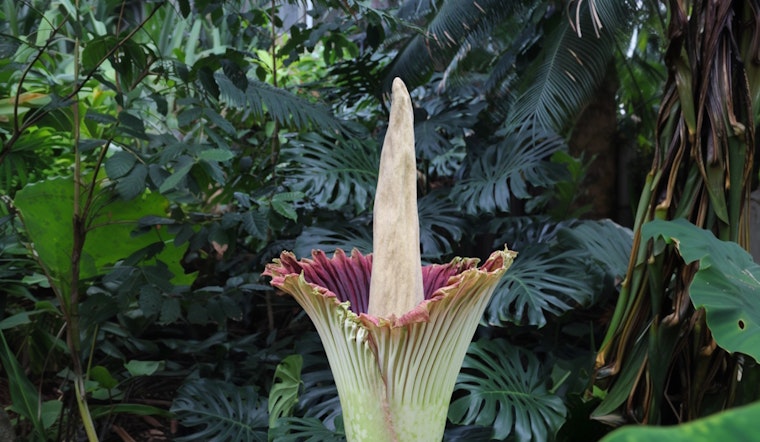
San Francisco's most notorious botanical resident is stirring to life, and it's about to make the Conservatory of Flowers smell like a crime scene. "Chanel" the corpse flower—a towering specimen that hasn't bloomed since 2022—is showing all the telltale signs of an imminent stench spectacular that typically draws thousands of visitors willing to wait in long lines for the privilege of smelling something described as rotting flesh mixed with gym socks.
The endangered Amorphophallus titanum, better known as a corpse flower, was predicted to bloom within 10-14 days as of June 27, according to Gardens of Golden Gate Park. That timeline puts the expected bloom right around this week, when the massive inflorescence will unfurl its burgundy "skirt" and begin emitting the pungent aroma that earned these plants their morbid nickname.
A Growing Bay Area Obsession
Ryan Guillou, Gardens of Golden Gate Park's director of collections and conservation, has been monitoring Chanel's progress closely, according to SFGate. The plant's signature odor—created by chemical compounds also found in Limburger cheese, sweaty feet, and rotting fish—serves an evolutionary purpose in its native Sumatran rainforests, where it attracts carrion beetles and flies for pollination.
The Bay Area has become something of a corpse flower hotspot in recent years, with multiple institutions housing these rare specimens. The California Academy of Sciences saw crowds flock to see their specimen "Mirage" bloom in February 2024, reports ABC7, while Como Zoo Conservatory in Minnesota recently celebrated "Frederick" reaching a record-breaking 81 inches during its June 2025 bloom, according to FOX 9.
From Mission Bathroom to Botanical Stardom
The Conservatory currently houses five corpse flowers, each with its own personality and blooming schedule. Previous specimens have earned colorful nicknames like Scarlet, Terra, Suma, and Amor, with some having rather unusual origin stories. Terra the Titan famously spent several years growing in a Mission District bathroom before finding its way to the Conservatory, where it grew from 18 inches to seven feet tall, reports Hoodline.
These botanical celebrities have developed something of a cult following. When Alameda nursery owner Solomon Leyva wheeled his blooming corpse flower to an abandoned gas station in 2021, more than 1,200 people lined up throughout the day to experience the rare event, according to Mercury News. The impromptu display became a neighborhood sensation, with visitors commenting that they'd previously had to wait hours behind barriers at formal botanical gardens.
Racing Against Time and Climate Change
The urgency surrounding these blooms extends beyond mere spectacle. With fewer than 1,000 individual plants remaining in the wild, the titan arum is listed as endangered by the International Union for Conservation of Nature, according to Gardens of Golden Gate Park. Habitat destruction from palm oil plantation expansion continues to threaten the species' native range on the Indonesian island of Sumatra.
The plants' rarity is matched by their unpredictability. Corpse flowers typically take seven to ten years to bloom for the first time, then may bloom again every three to five years—or not at all. When they do bloom, the window for experiencing the full sensory assault lasts just 24 to 48 hours, with the strongest scent typically occurring late at night when the plant reaches near-human body temperature to better disperse its aromatic calling cards, reports KALW.
Social Media Frenzy
The conservatory has been building anticipation on social media, encouraging followers to track @conservatoryofflowers for real-time bloom updates. Previous corpse flower events have generated significant online buzz, with visitors sharing photos and describing their olfactory experiences—though most agree the smell is simultaneously worse and more fascinating than expected.
During Scarlet's 2023 bloom, visitors on social media described the aroma as everything from "overripe vegetables" to "compost heap," with "stinky cheese" frequently mentioned as a runner-up comparison, according to San Francisco Chronicle. The conservatory has livestreamed previous blooms for those unable to visit in person, though most agree that experiencing the full effect requires being there in person.
The Business of Botanical Tourism
These rare events have proven to be significant draws for Bay Area tourism. During Terra's 2017 bloom, the conservatory saw over 1,000 additional visitors specifically seeking out the stinky spectacle, reports Hoodline. The institution typically extends its hours during blooms, offering special after-hours viewing sessions for $20 per person, while regular daytime admission remains free for San Francisco residents.
The Gardens of Golden Gate Park, a public-private partnership between the San Francisco Recreation & Park Department and the San Francisco Botanical Garden Society, has embraced these events as educational opportunities to discuss plant conservation and biodiversity. The partnership, which expanded in 2022 to include management of the Conservatory of Flowers alongside the Japanese Tea Garden and San Francisco Botanical Garden, serves more than 1.2 million visitors annually.
What to Expect
For those brave enough to seek out Chanel's bloom, the conservatory recommends arriving early and preparing for potential crowds. The plant is housed in the West Gallery, where the humid, enclosed environment helps concentrate the aromatic experience, according to SF Funcheap. Visitors should expect the full sensory package: a towering burgundy and green structure that can reach up to 10 feet tall, accompanied by an unforgettable smell that somehow manages to be both repulsive and fascinating.
The conservatory will likely announce extended hours once the bloom begins, following the pattern of previous corpse flower events. Those unable to visit in person can follow along via social media updates and potential livestreaming, though as any corpse flower veteran will tell you, the smell is definitely the main attraction.



