

























































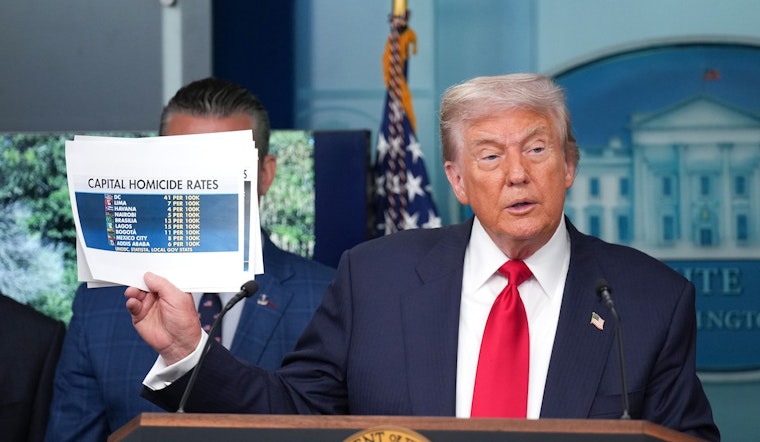
After President Trump invoked a rarely used authority to place Washington, D.C.'s Metropolitan Police under federal control on Aug. 11, 2025, he seemingly suggested other large, Democratic-run cities could be next. The claim — and the threat — raised a simple but urgent question for city leaders and lawyers: is this legally possible outside the unique context of the District of Columbia?
The short answer: mostly no — at least not in the way Trump did in D.C. The law the president cited, Section 740 of the District of Columbia Home Rule Act, applies only to the federal district and gives the president limited emergency authority over D.C.’s police; it is not a template for seizing local police departments in states. Outside the District, different rules govern who controls police and when federal forces can be used.
What Trump did in D.C. and why it’s different
On Aug. 11, Trump invoked Section 740 of the Home Rule Act to assert federal control of the MPD for an emergency purpose, and activated hundreds of National Guard members to the capital. That provision is specific to the District because Congress retained a higher level of oversight when it granted D.C. limited home rule in 1973. Local leaders pushed back immediately — calling the move unprecedented — and legal challenges were signaled within hours. (See coverage from Axios and The Washington Post.)
That D.C.-only pathway is crucial: the Home Rule Act’s emergency clause exists because the District sits under Congressional authority in a way states and their cities do not. As Time explains, Congress can—and did—leave special emergency language in the law governing how the federal government may act in the capital.
So what could the president do in Los Angeles, Oakland, Chicago, Baltimore or New York?
The president cannot simply “federalize” a municipal police department in a state the way he tapped the D.C. statute. For cities inside states, local police are creatures of state law; governors generally control the state National Guard, and municipal chiefs answer to mayors or county officials under state constitutions and statutes. Any direct federal takeover of a city police force would run up against those state-based chains of command and would almost certainly prompt immediate litigation, per legal scholars and news reporting.
That said, the federal government has several other levers it can and does use: the administration can surge federal law-enforcement agents (FBI, ATF, U.S. Marshals, Homeland Security), offer grant-funded task forces, or seek to federalize a state’s National Guard under the Insurrection Act — but each option carries limits and legal hurdles. The Insurrection Act allows the president to federalize the Guard or deploy federal troops in limited circumstances (insurrection, rebellion, or to enforce federal law) and requires specific statutory or constitutional triggers; it is not a catchall for routine crime fighting. Experts at the Brennan Center and codified law summaries note that the Posse Comitatus Act also constrains the use of active-duty military for civilian policing unless a statutory exception applies.
How courts and prior practice matter
Federal deployments for law enforcement have precedent — take Operation Legend and other 2020–2021 federal surges where DOJ sent agents to assist local authorities — but those operations typically worked through federal jurisdictions (federal crimes) or local consent. The more coercive step of placing an entire municipal force under federal authority is legally distinct and, again, largely limited to D.C. by statute. Past spikes in federal agent deployments prompted lawsuits and local resistance; a recent trial over the federal deployment to Los Angeles demonstrates how contested these moves can become in court.
What local leaders are saying
Washington Mayor Muriel Bowser called the D.C. action “unsettling and unprecedented,” while D.C. legal officials signaled challenges could follow. In cities Trump named — Oakland, Chicago, Baltimore and New York — officials have been blunt: Illinois Gov. J.B. Pritzker and Chicago Mayor Brandon Johnson dismissed the notion of federal troops overriding state authority, and Oakland and Baltimore leaders have emphasized falling crime trends in their jurisdictions as undercutting any emergency claim. Reporting on reactions and local crime data is available from Axios, WTTW in Chicago, and local police dashboards.
Legal implications — the quick blueprint
- District of Columbia: the Home Rule Act gives the president a narrow, D.C.-specific path to assume control during a declared emergency; Congress must be notified and any extension beyond 30 days requires congressional approval. (See Time and the Home Rule Act text.)
- Federal agents: the president can reassign federal law-enforcement personnel to assist or augment local work (FBI, U.S. Marshals, DHS units), typically focused on federal offenses; those moves normally don’t “federalize” local police. (See reporting and DOJ practice notes.)
- National Guard: governors command their state Guards unless the president federalizes them under statutory authority (e.g., Insurrection Act), which is legally and politically heavier and reserved for serious domestic disorder or to enforce federal law. (See legal summaries at LII and the Insurrection Act overview.)
- Active-duty military: Posse Comitatus limits use of the Army, Navy, Air Force and Space Force in civilian law enforcement, unless another statute (like the Insurrection Act) or the Constitution provides an exception. The Brennan Center outlines those constraints and exceptions in detail.
Why this matters beyond headlines
The D.C. move matters because it tests the edges of federal power and creates a template for political messaging: naming cities as “bad” and promising federal action shifts attention from local policy debates to constitutional tug-of-wars. Civil-liberties groups warn that normalizing federal interventions in city policing could chill local governance and erode trust between residents and law-enforcement — especially in majority-Black cities that have been singled out by the president. Local officials and civil-rights advocates are likely to mount legal and political fights if the administration attempts more aggressive, state-overriding moves.
Practically speaking, for Oakland, Chicago, Baltimore and New York the likely near-term outcome is greater federal coordination — task forces, prosecutions, or targeted federal deployments for federal crimes — not a wholesale takeover of municipal police. Any attempt at a broader, involuntary seizure of local law enforcement would face steep legal barriers and fast-moving court challenges.
Bottom line
What happened in D.C. used a statute written specifically for the District. Outside the capital, the Constitution, federal statutes and state authority combine to make a Trump-style federal takeover of local police implausible without cooperation from governors, clear statutory triggers, or an extraordinary invocation like the Insurrection Act. In short: the president can press federal law-enforcement resources and, in rare circumstances, federalize the Guard — but he cannot copy-paste Section 740 across America’s cities.
We’ll continue watching for legal filings and any new executive steps; for now, cities named by the president should expect political theater, tougher federal partnering offers — and, likely, courtrooms where the real fights will be decided.





