

























































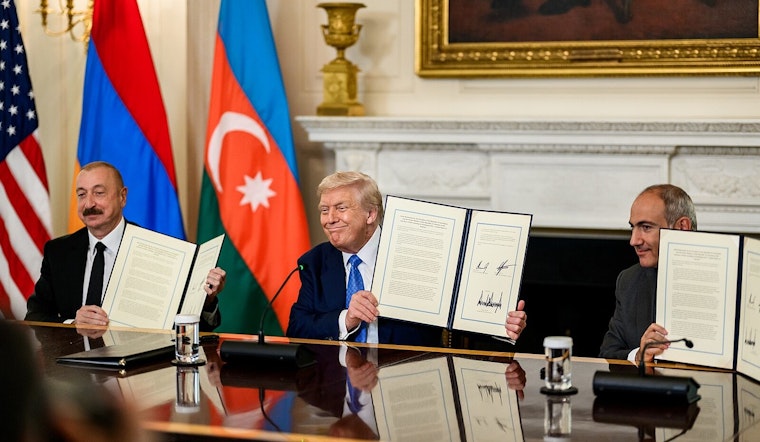
In a significant move that's bound to have long-reaching consequences for regional stability and international relations, the United States has released documents from a landmark meeting that took place earlier this month between Armenia's Prime Minister Nikol Pashinyan and Azerbaijani President Ilham Aliyev. Hosted by President Trump, this gathering has been widely regarded as a potential turning point for the South Caucasus region, which has seen its fair share of strife and contention.
The materials made public include a Joint Declaration by the President of Azerbaijan and Prime Minister of Armenia detailing the outcomes of their meeting in Washington, D.C. Furthermore, several Memoranda of Understanding (MoUs) were signed, aimed to not only solidify relationships but to also strategically leverage partnerships in various sectors such as AI, semiconductor innovation, and energy security. These endeavors are set to comprehensively enhance cooperation and forge a new path for both countries with the aid of the United States.
Under the terms of one MoU, the U.S. and Azerbaijan will establish a Strategic Working Group purposed to develop a Charter on Strategic Partnership. This signifies a keen intent by the United States to more deeply involve itself in the tapestry of regional alliances and to extend its influence as a broker of peace. On the other hand, Armenia will collaborate with the U.S. through a 'Crossroads of Peace Capacity Building Partnership', indicating a multifaceted approach toward ensuring sustainable peace in the area, according to the U.S. Department of State.
The geopolitical implications of these documents cannot be understated. With Armenia, an agreement was forged to jointly kickstart an AI and Semiconductor Innovation Partnership, signaling an ambition to closely integrate Armenia into the fold of next-generation technologies. The third MoU outlines an Energy Security Partnership that promises to materially change not only Armenia's energy landscape but also potentially to influence energy flows and security throughout the South Caucasus and beyond. As seen through these ambitious plans, the U.S. seems determined to immediately demonstrate its commitments on multiple fronts.
This trilateral cooperation framework heralds a hopeful epoch for Armenia and Azerbaijan, two nations historically dogged by the Nagorno-Karabakh conflict among other antagonisms. The United States, having brokered these agreements, positions itself as an instrumental peacemaker, looking to cement its role as a stabilizing force in an often-turbulent region.





