

























































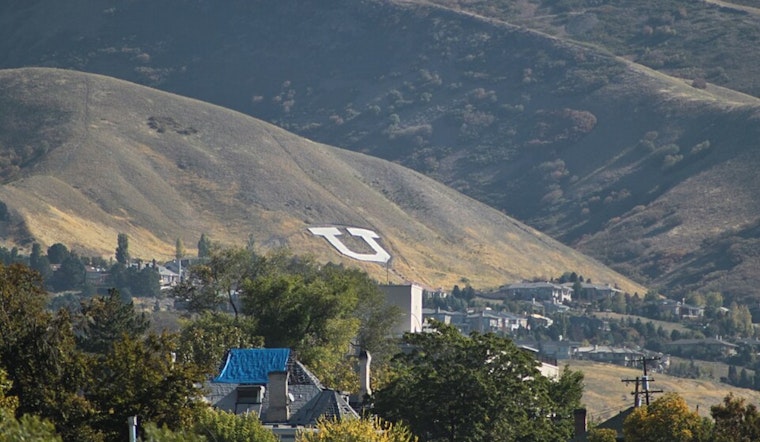
The University of Utah, marking its 175th anniversary, boasts a long list of achievements, including the establishment of the first public university in the Mountain West and the state's premier law, medical, and dentistry schools, not to mention the creation of the original artificial heart. But the "Block U," a staple of the school's history and a symbol indelibly linked to its identity, turns out to be only second in the tradition of hillside letters, a noteworthy bit of trivia for the history buffs out there, as the University of California at Berkeley's "C" predates it by a mere few months in 1905.
Beyond its silver-medal status, the Block U has evolved from a makeshift mound of rocks and limestone devised by hardy students in 1905 to a modern structure softened by the glow of in-built LED lights. The Block U is more than just a letter; it's an interactive feature. Come game day, these lights are set ablaze with the flick of a wirelessly controlled "switch" from the Merrill Engineering Building, making it a beacon of school spirit that can't be missed. The tradition of hiking up to the Block U remains robust, people flock to it "almost every day of the year," Richard Brown, U alum and dean emeritus of the College of Engineering, recalled in a statement obtained by At The U, it serves as a meeting spot for sweethearts, the occasional proposal, and familial visits all in the shadow of this historic monolith.
Once functioning as a navigational guide delineating graduation year for students with whitewashed stones, the Block U settled into permanence in 1907 with a limestone form, later to be outlined in light. A dazzling array of over 120 electrified glass lights was installed in 1967, with a color shift to red following home game victories, a navigational beacon, and a symbol of triumph, all wrapped into one. Its shape played a decisive role in the unification of the university's branding strategies throughout the turbulent '70s, '80s, and '90s when the institution grappled with multiple logos, often mired in the complexities of cultural insensitivity, until the Block U emerged as the consensus choice," according to Fred Esplin, a university historian and vice president for university advancement from 2006 to 2019, as per At The U.
Nevertheless, time and vandals took their toll; by 2001, the concrete was in shambles, lights shattered, and overgrowth ran amok. A crucial "Renew the U" campaign alongside alums Sue and Thayer Christensen in 2005 brought in $400,000, half of that matched by donors Ira and Mary Lou Fulton, to not only refurbish the Block U with robust concrete and modern LED lights but also to fund student scholarships with the leftover $250,000. Maintaining the site now entails an annual $15,000 budget from University Facilities and recent structural interventions, such as a retaining wall to staunch soil erosion from the trailhead leading to the revered letter symbolizing so much to students and alumni alike.





