

























































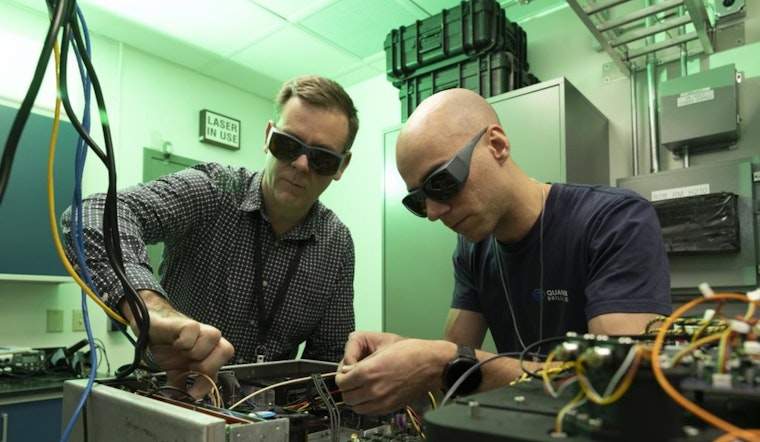
Quantum computing is taking a significant leap forward, with Quantum Brilliance installing the world's first cluster of parallelized quantum processing units (QPUs) into a classical high-performance computing (HPC) environment at the Oak Ridge Leadership Computing Facility (OLCF). The hybrid full-stack platform, known as the Quantum Development Kit (QDK), integrates QPUs with traditional CPU and GPU components, paving the way for advanced quantum-classical workflows. According to Quantum Brilliance, this installation at the Oak Ridge National Laboratory (ORNL) stands out because it operates at room temperature, unlike most quantum computers that require cryogenic conditions.
The system, featuring multiple qubits, is poised to unlock new possibilities in computational research. Andreas Sawadsky, Quantum Brilliance's technology and innovation manager, told the ORNL, "This is particularly exciting for us, as it’s the first time we’re delivering a multiple-hybrid system parallelized in a cluster." The deployment at ORNL follows previous installations at the Pawsey Supercomputing Centre in Perth and the Fraunhofer IAF in Freiburg, Germany, showcasing the company's growing global footprint.
Utilizing diamond-based solid-state spin quantum technologies, Quantum Brilliance has developed a unique platform where nitrogen vacancy centers in the diamond host the qubits functioning at room temperature. Sawadsky explained that these NV centers provide an environment "effectively equivalent to millikelvin conditions in other materials," which allows for a simpler and more accessible computing model. With a technology that eliminates the need for complex cooling systems, Quantum Brilliance is not just reducing the barriers to quantum computing deployment but also enabling significant miniaturization and portability potential, as stated on the ORNL website.
The company's approach is distinctly practical, aiming to integrate quantum computing seamlessly within HPC settings. Their objective, as outlined, is to produce QPUs that can compete with classical systems on size, weight, and power parameters. Furthermore, the scalability of their robust, portable technology is a key focus, with the potential to challenge classical accelerators like GPUs directly in real-world applications. At ORNL, the scalability of the QPUs is being explored, with the idea being that if one QPU can outperform one GPU, then a cluster of 100 QPUs could similarly surpass a cluster of 100 GPUs.
The newly installed cluster has been whimsically named "Quoll," reflecting the Australian roots of Quantum Brilliance and a nod to their architectural approach for scalable quantum acceleration. With significant scientific and commercial talent onboard and partnerships spanning across continents, Quantum Brilliance is well-positioned in the evolving landscape of quantum technology, striving to bring quantum computing into daily technological applications and HPC environments on a global scale.





