

























































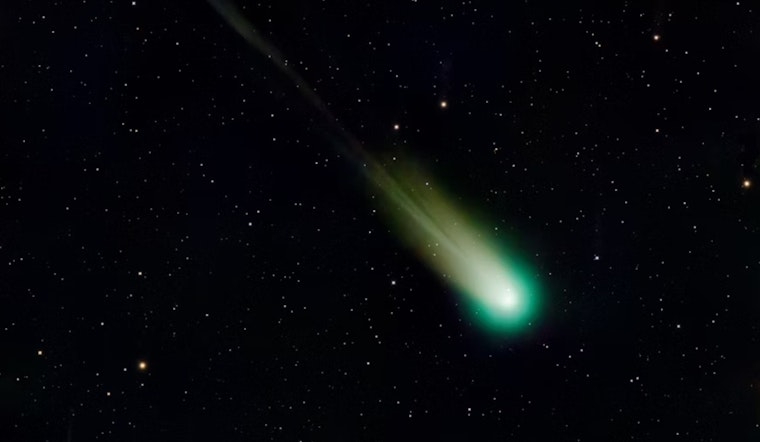
Stargazers in California are in for a treat as Comet C/2025 A6 (Lemmon) makes its closest pass to Earth this week, presenting a unique viewing opportunity that won't come again for over a millennium. The comet, first spied in January by the Mount Lemmon Survey near Tucson, Arizona, is expected to stand out as the brightest comet of the year and can be observed near the constellations Scorpius or Libra shortly after sunset, as reported by SFGATE and National Geographic.
To get the best view of the green-hued comet, which owes its color to diatomic carbon molecules, Gerald McKeegan, an adjunct astronomer at Chabot Space and Science Center, suggests finding a dark location away from city lights, about 45 minutes to an hour after sunset Gerald McKeegan told SFGATE, you might need binoculars to catch the best glimpse of it, although it may be visible to the naked eye. Meanwhile, the chance for observation is further supported by the timing with the new moon, providing darker skies that are favorable for spotting celestial events, according to Rhonda Stroud, the director of the Center for Meteorite Studies at Arizona State University, in a statement per National Geographic.
However, the weather could pose a setback for eager viewers. The forecast predicts clouds could obstruct the comet's visibility due to an atmospheric river expected to pass through the Bay Area soon. SFGATE relayed a warning from Roger Gass, a meteorologist for the National Weather Service's Bay Area office. Stroud emphasized the value of comets like Lemmon in scientific study, describing them as "treasure troves of the original building blocks of our solar system," and that their composition remains largely unchanged for billions of years, as per National Geographic.



