

























































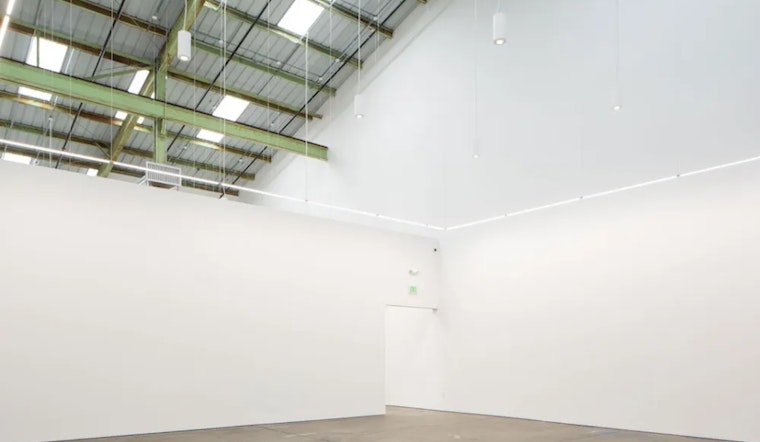
One of San Francisco's most influential contemporary art galleries is shutting down in November. Altman Siegel announced its closure on Wednesday after 16 years of championing conceptual art and launching careers in the Bay Area's increasingly precarious gallery ecosystem.
Founder Claudia Altman-Siegel called the decision "incredibly tough," but framed it as a principled choice to maintain artistic integrity rather than downsize. "As it has become too difficult for a gallery this size to scale in this climate, I have made the incredibly tough decision to close rather than diminish either the space or the commitment to exhibit conceptually uncompromising work," she wrote on the gallery's website.
The Dogpatch gallery will hold its final day on November 22, with a closing exhibition featuring new works by Tokyo-based painter Shinpei Kusanagi, an artist who has shown with Altman Siegel since its inception.
A 16-Year Trajectory
Altman-Siegel arrived in San Francisco in 2007 inspired by the city's counterculture legacy and rigorous arts community. She opened her first show in 2009 at 49 Geary, a historic downtown gallery hub, with "A Wild Night and A New Road," a group exhibition named after an Emily Dickinson poem. The program quickly gained traction, establishing itself as a serious curatorial voice dedicated to artists asking urgent questions about technology, society, and visual practice.
In 2016, the gallery relocated to a sprawling 5,000-square-foot space at Minnesota Street Project in Dogpatch, a converted industrial complex now housing multiple galleries and artists' studios. Four years later, Altman-Siegel expanded to a Presidio Heights venue for more intimate presentations. According to her statement, Altman Siegel presented 213 exhibitions and art fair presentations across these locations.
The roster tells a story of curatorial discernment and artist development. Bay Area figures like Liam Everett, Chris Johanson, Lynn Hershman Leeson, and Trevor Paglen gained significant institutional traction through Altman Siegel representation. Hershman Leeson, whose work ranged from electronic diaries to new works on paper, called the gallery's support "essential" to her gaining wider recognition that led to major retrospectives at the New Museum in New York and recognition at the Venice Biennale.
Part of a Larger Reckoning
Altman Siegel's closure marks the third significant San Francisco gallery shutdown in 2025, following what proved to be an "unwelcome" summer for the city's arts institutions. ARTnews reported KADIST's closure, a world-renowned nonprofit focused on contemporary commissioning that shuttered its Mission District location in June after 14 years, and Gallery 16, an institution with deep roots in Bay Area artist development, shuttered after 32 years of operation.
Wendi Norris, who operates her eponymous Jackson Square gallery and is a keen observer of the art market, expressed the emotional toll these closures exact on the community. "Gut-wrenching is the first word that came to mind for me," she told SF Standard. "There are few galleries that operate at their level in the San Francisco community, and I'm proud to call her a colleague."
The closures reflect a national contraction in the commercial gallery sector. According to ARTnews, galleries across Los Angeles, New York, and other major art markets have announced shutdowns or pivots to private dealing in recent years, with LA's 50-year-old LA Louver Gallery shifting away from public viewing in September 2025. This suggests the challenges facing mid-size galleries are industry-wide rather than unique to San Francisco.
The Institutional Context
San Francisco's art market has long occupied a particular niche within the national gallery ecosystem. When Altman-Siegel launched her gallery in 2009, she told Art in America that "San Francisco is a smaller market, so local sales are fewer and foot traffic is slower than in New York, but there is a lot of creative freedom; I have no peer pressure, and there's not much competition." Over 16 years, that calculation shifted dramatically. The combination of skyrocketing real estate costs, changing collector behavior, and the post-pandemic art market contraction has made it increasingly difficult for mid-size galleries to maintain the operational overhead required for ambitious programming.
Aimee Le Duc, executive director of campus experience at Minnesota Street Project, expressed sadness about losing a tenant but respect for Altman-Siegel's decision-making. "We are very sorry to see them go but we certainly understand and respect her reasons for closing," Le Duc said. The organization said it would prioritize seeking another arts institution for the vacated space.
What's Being Lost
Beyond institutional infrastructure, these closures represent a loss of curatorial attention and community gathering space. Altman-Siegel's closing statement reveals something about what the gallery valued—moments of connection over market metrics. She recalled recently standing in the gallery watching artist Liam Everett experience Lynn Hershman Leeson's work for the first time, describing how gallery staff spontaneously joined them in discussing technology, immortality, feminism, and art history.
"This is an example of the small moments of connection that have defined Altman Siegel," she wrote. "It underscores that while the art market can be relentless, the true heart of this project has always been ideas, community, and joy."
The closure happens at a moment when other San Francisco arts institutions are navigating their own precarity. KQED noted that the city's donor-dependent arts spaces are increasingly viewed as temporary gifts to the community rather than permanent fixtures, a structural vulnerability that has become impossible to ignore.
For the next five weeks, San Francisco residents and art enthusiasts still have an opportunity to visit Altman Siegel. The final exhibition of Shinpei Kusanagi's paintings opens October 17 and runs through November 22 at 1150 25th Street in Dogpatch.




