

























































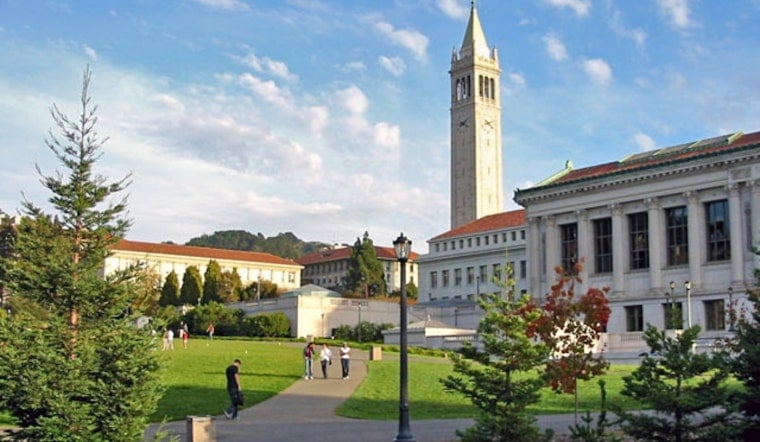
In a historic win for Bay Area science, UC Berkeley emeritus physics professor John Clarke has been awarded the 2025 Nobel Prize in Physics, becoming the university's 27th faculty member to receive the prestigious honor. The British-born physicist, who has called Berkeley home since 1969, shares the award with two colleagues who were once part of his research team during the groundbreaking experiments that would ultimately reshape our understanding of quantum mechanics.
Clarke split the prize with Michel H. Devoret and John M. Martinis—both of whom worked alongside him at Berkeley in the mid-1980s when they conducted the experiments that earned them this year's recognition. The Royal Swedish Academy of Sciences honored the trio "for the discovery of macroscopic quantum mechanical tunneling and energy quantization in an electric circuit," according to the Nobel Foundation.
The timing couldn't be more fitting for Berkeley's quantum computing ambitions. Just last week, California Governor Gavin Newsom visited Campbell Hall on the Berkeley campus to sign Assembly Bill 940, creating "quantum innovation zones" across the state—legislation specifically designed to transform California's quantum research into a trillion-dollar industry, as reported by Berkeley News. The bill, authored by Assemblymember Buffy Wicks after conversations with Berkeley faculty, allocates public funding to support quantum computing economy development.
From Theory to Reality: Quantum Effects You Can Hold in Your Hand
What makes this prize particularly remarkable isn't just the science—it's the scale. The experiments Clarke and his team conducted in 1984 and 1985 demonstrated that the bizarre, counterintuitive behaviors of quantum mechanics weren't confined to the invisible world of atoms and subatomic particles. They proved these effects could manifest in electrical circuits large enough to hold in your hand, according to the Nobel Committee's summary.
Working with Martinis, then a graduate student, and postdoctoral fellow Devoret from France's Centre d'Etudes Nucleaires de Saclay, Clarke devised an experiment using a quantum device called a Josephson junction. The experiment clearly proved that the circuit-based oscillator had quantized energy levels—discrete steps of energy absorption and emission, just like an atom. "The fact that you can see the quantum world in an electrical circuit in this very direct way was really the source of the prize," Irfan Siddiqi, chair of UC Berkeley's Department of Physics, told Berkeley News.
Clarke himself seemed genuinely stunned by the recognition. "To put it mildly, it was the surprise of my life," he said during a phone call with the Nobel committee that was patched into the Stockholm press conference, as reported by Berkeley News. That his work was Nobel Prize worthy "had not occurred to us in any way."
The Foundation of Today's Quantum Revolution
These weren't just abstract physics experiments conducted in ivory tower labs. Clarke's work laid the essential groundwork for the superconducting quantum bits—or qubits—that power many of today's quantum computers. The discovery opened doors to next-generation quantum technologies including quantum cryptography, sensors, and computing systems that could revolutionize everything from drug discovery to cybersecurity, according to the University of California.
"One of the underlying reasons that cellphones work is because of all this work," Clarke said during the Nobel announcement, speaking from his cellphone, according to Berkeleyside. The irony wasn't lost on reporters at the press conference.
The experiments were largely funded by Lawrence Berkeley National Laboratory, where Clarke worked as a faculty senior scientist in the Materials Sciences Division until his retirement in 2010, as noted by Berkeley Lab. "John Clarke was a leading faculty scientist at Berkeley Lab for many years, supported by the Department of Energy's Basic Energy Sciences program," said Berkeley Lab Director Mike Witherell.
A Bay Area Week of Genius Recognition
Clarke's Nobel win comes during a remarkable week for Bay Area intellectual achievement. Just yesterday, three Bay Area residents were named among the 22 recipients of MacArthur Foundation "Genius Grants," each receiving $800,000 in no-strings-attached funding. Oakland novelist Tommy Orange, UC Berkeley neurobiologist Teresa Puthussery, and Stanford chemical engineer William Tarpeh joined the prestigious cohort, as reported by SFGATE. The concentration of such prestigious recognition in a single week underscores the Bay Area's continued dominance as a global innovation hub.
Orange, whose 2018 novel "There There" illuminated Native American experiences in Oakland, represents the literary excellence that complements the region's scientific achievements. Puthussery's work identifying specialized retinal cells advances our understanding of human vision, while Tarpeh's wastewater resource recovery techniques address critical sustainability challenges, according to Press Democrat.
Berkeley's Nobel Legacy and Quantum Future
Clarke's win marks the 62nd time either a UC Berkeley professor or someone trained at Berkeley has won a Nobel Prize, cementing the campus's reputation as a Nobel laureate factory, according to Mercury News. He's the fourth Berkeley faculty member to win in the past five years, following Jennifer Doudna's 2020 Chemistry prize for CRISPR gene-editing technology and Reinhard Genzel's 2020 Physics prize.
Berkeley Chancellor Rich Lyons emphasized how Clarke's fundamental research exemplifies the university's role in quantum innovation. "Berkeley's ability to play an essential role in this initiative—and similar ones across the scientific spectrum—would not be possible without extraordinary scholars like John Clarke," Lyons said, as quoted by Berkeley News. "Their work and discoveries in fundamental scientific research so often set the stage for the development of new technologies, products, and services that support the prosperity, health and well-being of people around the world."
The campus is already building infrastructure to capitalize on quantum computing's promise. A new "Quantum Nexus" will open this fall in the old Masonic Temple in downtown Berkeley, creating a convergence space for scientists, students, policymakers and industry leaders, according to Berkeley News. The facility will support the Challenge Institute for Quantum Computation, a National Science Foundation-funded collaboration drawing together UC Berkeley, UCLA, UC Santa Barbara, Caltech, Stanford, and soon the California State University system.
The Human Element: Collaboration and Surprise
Despite leading the research group, Clarke was quick to credit his co-laureates' contributions. "I was in principle the leader of the group, of course, but their contributions are just overwhelming," he told reporters during the Nobel announcement, according to Research UC Berkeley. He noted that the discovery wouldn't have happened without the work of both Devoret and Martinis.
Born in 1942 in Cambridge, United Kingdom, Clarke earned his BA and PhD in physics from Cambridge University in 1964 and 1968 respectively. After a postdoctoral fellowship at UC Berkeley, he joined the physics faculty in 1969 and has remained connected to the campus ever since, according to Research UC Berkeley. He's a Fellow of the Royal Society of London and an Honorary Fellow of Christ's College, Cambridge, among numerous other honors including the 1987 California Scientist of the Year award.
The prize carries not just prestige but also a cash award of 11 million Swedish kronor—approximately $1.2 million—which the three laureates will share equally, according to NobelPrize.org. The award ceremony will be held December 10, the anniversary of Alfred Nobel's death.
Why This Story Matters Now
The convergence of Clarke's Nobel recognition, California's new quantum innovation legislation, and the MacArthur "Genius Grant" awards to Bay Area innovators paints a picture of a region doubling down on its position as a global technology leader. As quantum computing transitions from laboratory curiosity to commercial reality—with applications ranging from unbreakable encryption to drug development to climate modeling—the Bay Area appears positioned to capture much of that trillion-dollar opportunity.
At a celebration in Campbell Hall following the announcement, Chancellor Lyons presented Clarke with a special perk befitting a Nobel laureate: a coveted "Nobel Laureate's parking pass" for campus, according to Mercury News. It's a small gesture that speaks to the university's pride in its latest Nobel winner—and perhaps a recognition that even quantum physicists who can make particles tunnel through barriers still struggle with Berkeley parking.



