

























































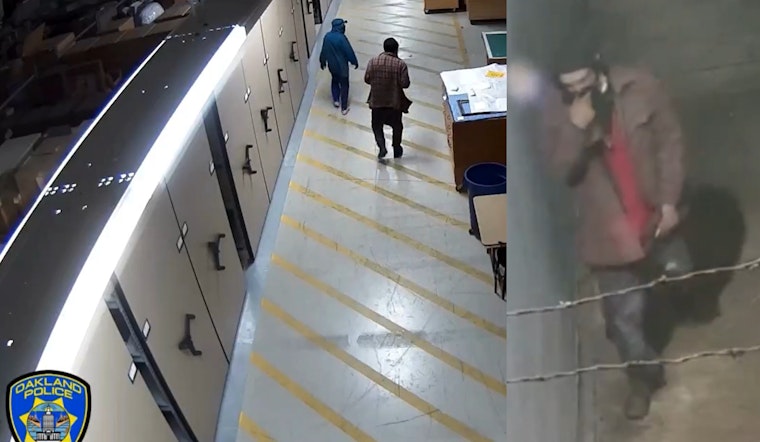
Three weeks after thieves made off with more than 1,000 artifacts from the Oakland Museum of California, police and the FBI have released surveillance footage that offers the public its first glimpse of the suspected perpetrators—and according to experts, it reveals more about their amateur approach than any sophisticated planning.
The video, released Monday afternoon by the Oakland Police Department, shows two individuals meandering through the museum's off-site storage facility in the early morning hours of October 15. One suspect, described as a thin male, sports a black beanie, white face mask, and plaid long-sleeve shirt, while his heavier-built accomplice wears a blue hoodie with white lettering, appearing to rifle through shelves as if window shopping rather than executing a calculated heist.
OPD and the FBI are seeking the public's help in identifying two individuals, depicted in the attached video, who are believed to be responsible for the theft of items belonging to an Oakland museum.
— Oakland Police Dept. (@oaklandpoliceca) November 3, 2025
More belowhttps://t.co/eSYq6N8xtV pic.twitter.com/7mAMCQThRy
Amateur Hour at the Museum Warehouse
"They were just kind of meandering to a certain degree," former FBI special agent Robert Wittman told ABC7 News after reviewing the footage. "I don't think they really knew what they were looking for. They were just walking around trying to take a shot at whatever they could get."
This assessment aligns with what museum officials have been saying since they first broke their silence about the theft last week. According to San Francisco Standard, investigators now believe the perpetrators didn't even realize they were breaking into a museum storage facility—they simply grabbed what was easiest to carry.
The surveillance footage reveals another critical mistake that may help investigators: the suspects wore distinctive, identifiable clothing. Wittman noted this error could prove crucial in tracking them down, especially as the FBI Art Crime Team—a specialized unit of about 20 agents nationwide—continues its investigation alongside Oakland police.
The Race Against Time
What makes this case particularly urgent is the risk that the suspects might destroy the artifacts to avoid being caught. "That's what's scary and terrifying about the situation, because you don't want to lose those artifacts," Wittman explained to ABC News. "They're much more important than they are financially, much more important to the community."
Among the stolen items are six Native American baskets—artifacts that carry particular cultural significance. The California tribe affiliated with these baskets has requested anonymity while maintaining ongoing conversations with the museum about their loss, as reported by KQED.
Also missing are several 19th-century scrimshaw pieces, daguerreotypes, and modernist metalwork jewelry by late California artist Florence Resnikoff—items valuable not for precious gems but for their historical merit. The bulk of the haul consisted of more mundane memorabilia: political pins, award ribbons, and souvenir tokens that the thieves likely grabbed indiscriminately.
Security Questions and Past Precedents
The heist has raised uncomfortable questions about security at the 100,000-square-foot facility, which houses the majority of the museum's 2 million-object collection. According to The Oaklandside, while the building had security cameras and alarms, no staff members were present during the overnight theft.
"I see an opportunity where things could have been different is the presence of on-site security," security executive Derek Morgan told ABC7 News. "There is a difference between monitoring and security."
This isn't the Oakland Museum's first experience with theft. The institution was hit twice in 2012 and 2013 by Andre Taray Franklin, who was later convicted and sentenced to four years in prison. In those incidents, Franklin made off with gold nuggets, an antique six-barreled pistol, and an $800,000 Gold Rush-era jewelry box—though only the jewelry box was recovered after Franklin sold it to a business owner for a mere $1,500.
Legal Implications and Federal Involvement
The involvement of the FBI Art Crime Team underscores the federal nature of museum theft. As museum CEO Lori Fogarty noted to reporters, "Stealing from a museum is a federal crime." The specialized FBI unit handles not just art theft but also forgery, fraud, and cultural property trafficking—expertise that could prove crucial in recovering the stolen artifacts.
Former LAPD detective John Romero suggested to the Los Angeles Times that whoever planned the heist might have had insider knowledge, given the facility's nondescript nature. However, Wittman's analysis of the video suggests otherwise—noting that 89% of museum thefts in the U.S. typically involve an insider component, he expressed hope this case falls into the remaining 11%.
A Global Context of Museum Vulnerability
The timing of the Oakland heist is particularly striking—it occurred just four days before thieves made off with approximately $102 million in Napoleonic crown jewels from the Louvre in Paris. While the incidents appear unrelated, they've drawn international attention to museum security vulnerabilities.
Alexander Eblen, a senior jewelry specialist with Christie's in New York, told San Francisco Standard that the contrasting nature of the two heists is telling: "Most of the time when you're dealing with large-scale theft like this, you're not typically dealing with the most sophisticated thieves. Juxtapose that with what was stolen from the Louvre, and those people knew exactly what they were stealing."
The Oakland Police Department strategically waited two weeks before announcing the burglary to avoid jeopardizing the investigation. Now, with the video release, they're hoping someone will recognize the suspects or spot the stolen items surfacing at flea markets, pawn shops, or antique stores.
Anyone with information about the theft is urged to contact the Oakland Police Department's Burglary Section at 510-238-3951 or submit a tip to the FBI at tips.fbi.gov or 1-800-CALL-FBI. Tips may remain anonymous, and investigators are particularly interested in hearing from anyone who might have seen the distinctive clothing worn by the suspects or encountered any of the stolen artifacts in secondary markets.



