

























































Researchers at Oak Ridge National Laboratory (ORNL) have teamed up with peers from several prominent institutions to boldly step into a new era of quantum materials innovation. In a detailed report covered by ORNL, the project named CONNEQT (Controlled Numerics for Emergent Transients in Nonequilibrium Quantum Matter) will span four years and capitalize on high-performance computing (HPC) to advance our understanding of nonequilibrium quantum materials.
The partnership includes players from Los Alamos and Lawrence Berkeley National Laboratories, SLAC National Accelerator Laboratory, and the University of Tennessee, Knoxville. The goal is to decipher the riddle of how quantum materials behave when driven by external forces such as magnetic fields or temperature changes. "Driving these materials out of equilibrium to manipulate the delicate balance between their complex interactions has emerged as a powerful strategy to engineer quantum phenomena on demand," Thomas Maier, a distinguished research staff member and section head at ORNL, explained in a statement made by ORNL.
With this effort, the collaboration hopes to fundamentally change to revolutionize computational modeling of quantum materials. Advanced mathematical tools and computer science techniques will be harnessed with the objective of shedding light on the behaviors that emerge amidst the chaos of nonequilibrium states. "By leveraging leadership-class exascale computing, we aim to revolutionize computational modeling of transient emergent behavior in quantum materials with strong many-body interactions and deliver a new fundamental understanding of nonlinear quantum phenomena," Maier told ORNL.
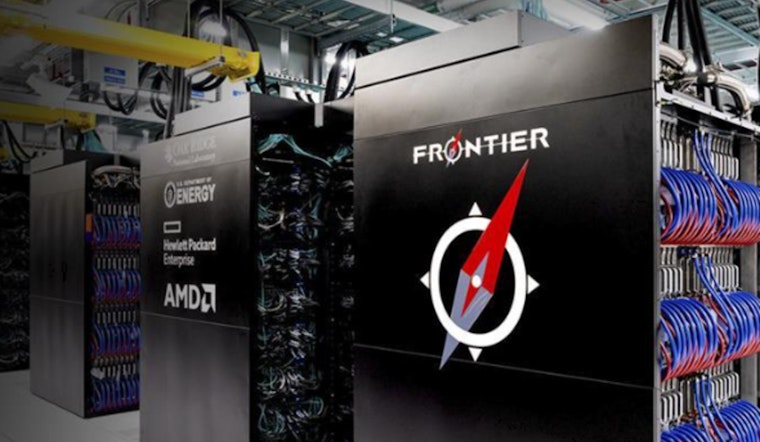
The applications of such research are promising and broad, potentially accelerating scientific discovery in quantum materials research, which can, in turn, inform future energy technologies. The consortium's efforts will be supported by the Scientific Discovery through Advanced Computing program, with DOE’s Office of Science funding the initiative. ORNL's Frontier supercomputer, the first of its kind to break the exascale computing barrier, is set to be the testing ground for the team's developed algorithms. These advances underpin the DOE's Genesis Mission, which is aimed at boosting America's scientific discovery, energy innovation, and national security through AI and exascale-powered research.





