

























































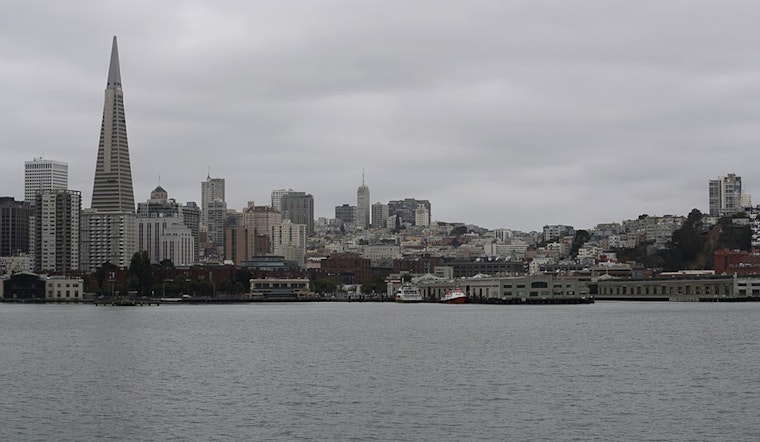
So much for the big dry spell. Parts of the Bay Area woke up Thursday to something they haven't seen in weeks—actual rain falling from the sky. Well, sort of. While forecasters are calling it "sprinkles to very light rain," and accumulation is measured in hundredths of an inch, any moisture at all feels newsworthy after two solid weeks of relentless sunshine.
The action is mostly happening south of the Bay Area proper. National Weather Service forecasters in Monterey stepped outside early Thursday morning to confirm that, yes, very light rain was actually hitting the ground. The Santa Lucia Range picked up a trace of rain in the past six hours, while areas just south of the San Luis Obispo county line saw up to a tenth of an inch—practically a deluge by recent standards.
Why the Bay Area Is Mostly Missing Out
Here's the meteorological explanation for why your neighborhood probably stayed dry: the air is too thirsty. A weather system—what forecasters call a "cut-off low"—is sitting offshore, pumping scattered showers across the Central Coast. But as that rain tries to fall over the Bay Area, it's evaporating before it reaches the ground. Monterey Airport showed decent moisture at lower levels (81% relative humidity near the surface), while San Jose was much drier (65% near the surface, 48% higher up). That drier air gives falling raindrops more room to evaporate mid-flight, which is why most Bay Area residents won't see more than maybe a sprinkle, if that.
"Cannot fully rule out a very light rain making it to the ground in the Bay Area but it will be a lot more difficult," forecasters wrote in their early morning discussion, managing expectations with admirable precision. The scattered showers should persist through mid-morning across the Central Coast, then taper off as the cut-off low continues its southward journey down the California coastline.
The Pattern Everyone's Been Waiting For
This weak system is exactly what forecasters predicted earlier this week—a cut-off low that would clip southern portions of the region with minimal moisture while leaving most of the Bay Area high and dry. It's not the drought-busting rain everyone's hoping for, but it does signal that the stubbornly persistent high pressure ridge is finally, actually, genuinely breaking down. The cut-off low will continue south on Friday before moving inland over Baja California and merging with a larger weather system over the Central U.S. this weekend.
Once it clears out, the ridge rebuilds—but this time only temporarily. The forecast calls for dry weather and seasonal temperatures (upper 50s to low 60s) through most of next week, but forecasters are keeping a close eye on what happens at the end of January. Multiple long-range models show an active Pacific pattern with a series of strong weather systems developing offshore. Most look like they'll stay well to the north, but there are hints the ridge could break down again, potentially bringing rain back by late January or early February.
The Great Model Disagreement
Here's where it gets interesting for weather nerds: the forecast models can't agree on what happens next. The European model is "much more confident that upper level troughing and rain will return," while the American GFS model is "more pessimistic and keeps upper level ridging in place," according to the NWS. The European ensemble members nearly all show rain returning, while only a handful of GFS ensemble members do.
This disagreement is worth paying attention to because it's happening more than a week out—typically when forecast confidence starts to crumble. The fact that one major model system shows high confidence in rain while another doesn't suggests we're at a pivotal moment in the weather pattern. Either way, forecasters are urging people to "stay up to date on the forecast as models come into better agreement on ridging vs troughing."
Weekend Wind Warning
While rain remains elusive for most, wind is about to become very real for parts of the North Bay and East Bay Hills. Gusty offshore winds are expected to strengthen Friday night and continue through Saturday, with gusts between 20 to 30 mph and locally stronger gusts possible across the highest peaks. The driver is a developing coastal trough along the California coastline, combined with high pressure rebuilding over Nevada and the Northwest—a setup that creates a strong pressure gradient favoring offshore flow.
The technical details are impressive: forecasters are tracking a low-level jet at 925 millibars (about 2,500 feet up) peaking around 30-40 knots over the interior North Bay early Saturday morning. A few stronger gusts may even mix downward into neighboring valleys. The overall fire weather threat remains low, but there's still a small chance that dry winter fuels could support some fire growth if ignitions occur. It's not the kind of scenario that keeps fire officials up at night, but it's worth noting given how dry things have been.
Fog Makes a Comeback
Thursday night into Friday morning looks ripe for widespread fog across interior valleys, thanks to increased surface moisture from Thursday's passing system and calm winds. Unlike the dense, localized fog patches of recent mornings, this could be more extensive. Morning temperatures will stay seasonal with lows in the 40s across lower terrain and upper 40s to low 50s in higher elevations, but starting Saturday, things get progressively chillier. Morning lows will drop into the mid to upper 30s across the region and trend "seasonally cool" through the middle of next week.
For marine interests, fresh northerly breezes and building seas are developing mainly over the northern outer waters Thursday into Friday. Near-gale force winds from Friday morning through late Friday night will create hazardous conditions for small craft, prompting a Small Craft Advisory for the area from Point Arena to Point Reyes (10-60 nautical miles offshore) from 3 PM Thursday to 3 AM Saturday. Seas will gradually ease Saturday afternoon and remain light to moderate into early next week.
Not the Rain We Need, But the Rain We Got
Thursday's sprinkles won't make a dent in the rain deficit or do anything meaningful for water supplies. But after two weeks of watching that stubborn high pressure ridge dominate the forecast, even a trace of rain feels significant.




.jpg)