

























































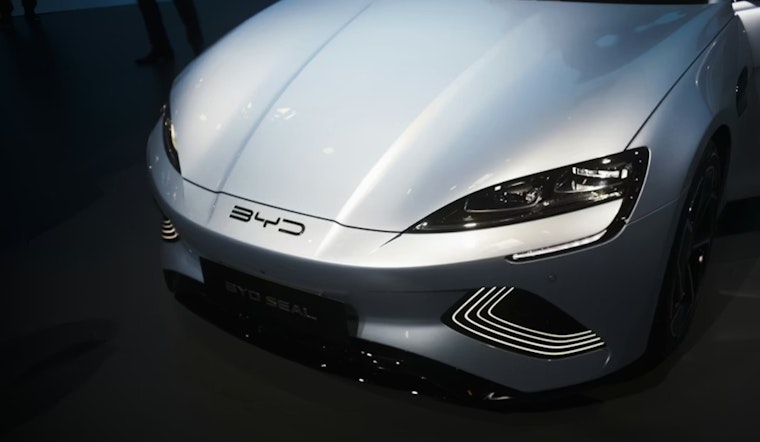
Tesla, once synonymous with the forefront of electric vehicle innovation, has officially been dethroned as the world's largest seller of EVs. After a tumultuous year marked by factors ranging from CEO Elon Musk’s political stance to intensifying global competition, Tesla's sales declined by 9% in 2025, with the company delivering 1.64 million vehicles compared to its rival BYD's 2.26 million, as reported by ABC7. The decrease marks the second consecutive year of declining sales for the company.
According to SFGATE, Tesla’s sales were notably impacted by the cessation of a $7,500 tax credit for electric vehicle (EV) purchases, a legacy of the Trump administration that expired at the end of September. A customer shift concerning Musk’s political inclinations and the severe competition Tesla faced overseas were instrumental in eroding Tesla's market share. Despite the setbacks, investors remain sanguine, evidenced by the 11% uptick in Tesla’s stock by the year’s end, awaiting Musk’s promised advances in robotaxi services and AI humanoid robotics.
Feeling the pressure, Tesla introduced lower-priced versions of its Model Y and Model 3 in the fourth quarter, positioning them below the $40,000 and $37,000 marks, respectively. These models are part of Tesla’s strategy to reinvigorate sales, particularly in competitive markets in Europe and Asia, where Chinese models have been attracting cost-conscious consumers. Despite these efforts, Tesla's fourth-quarter sales still fell short at 418,227, missing the revised analyst target of 440,000 from FactSet.
Challenges continue to loom on the horizon for Tesla as it begins to roll out its autonomous robotaxi service amid ongoing federal safety investigations and the potential temporary suspension of its sales license in California. Even so, Wedbush Securities analyst Dan Ives remains optimistic about Tesla’s future in autonomous technologies. "Regulatory is going to be a big issue," Ives noted, per ABC7, emphasizing the gravity of public safety in the development of driverless systems. Tesla also eyes the upcoming production of its AI-driven Cybercab, intended to operate without human input thanks to software updates, aiming for a steering-wheel-free and pedal-less experience in 2026.



