

























































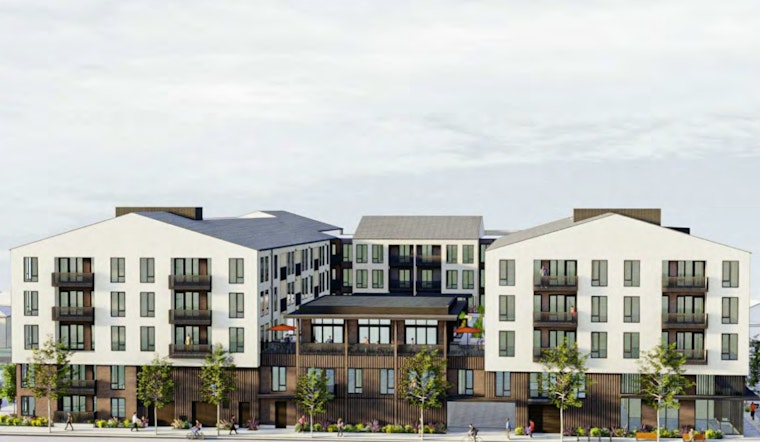
The long-brewing fight over a controversial Masonic Way housing project has officially moved from council chambers to a courtroom, as a group of Belmont neighbors sues the city over what they say are broken promises on public amenities and local control.
The Belmont Village Community Association filed its complaint in late January after the City Council upheld approval of a five-story housing development on Masonic Way. The suit argues the plan abandons commitments to publicly accessible ground-floor spaces and improperly sidelines local zoning power. It also claims city planners wrongly treated the Belmont Village Specific Plan's objective design standards as not applicable and that the city attorney endorsed that approach, casting the case as part of a broader clash between neighborhood place-making goals and state laws that streamline qualified housing projects.
The proposal for 500–580 Masonic Way would demolish an existing retail center and put up a roughly 183,467-square-foot, five-story building with 140 apartments - including 25 affordable units - plus parking, according to the City of Belmont. City staff say the site lies in the Belmont Village Specific Plan's Station Core and that, because the project meets state density-bonus and housing-element thresholds, it qualified for by-right processing limited to objective standards. The Planning Commission signed off on the design in August, and the City Council later denied an appeal and adopted the entitlements on Oct. 28, 2025, per the City of Belmont.
In its late-January filing, the Belmont Village Community Association says the project lacks publicly accessible ground-floor amenities and that staff erroneously determined the Specific Plan standards to be not applicable, as reported by the San Mateo Daily Journal. A BVCA spokesperson told the paper the group is suing to uphold the power of city councils over their zoning and argued that ground-floor retail could be added without cutting the number of homes. The lawsuit asks the court to throw out the city's approvals and require the project to comply with the Specific Plan's active-use requirements for the ground floor.
City staff and some planning commissioners have countered that recent state housing laws and density-bonus rules significantly narrow what local governments can demand from qualifying projects. The city attorney repeated that interpretation during the council appeal hearing, the City of Belmont record shows. According to the minutes, the city attorney framed the council's decision as an administrative determination governed by state statutes, including the Housing Accountability Act, which the city says constrains any attempt to revisit issues that were not raised in the project's compliance letter.
The BVCA complaint takes direct aim at that legal advice, calling it erroneous and arguing the city's approach unconstitutionally disenfranchises residents and their elected council. Both the city and developer Prometheus Real Estate Group declined to comment on the pending case, the San Mateo Daily Journal reports.
The Belmont Village Community Association describes itself as focused on preserving a "vibrant, walkable downtown" and says the Specific Plan's active-use language is central to that vision, per the group's Belmont Village Community Association. At public hearings, neighbors also raised traffic and school-safety concerns and pointed to earlier planning documents they say envisioned more active ground-floor uses on the site.
Legal Implications
If a judge agrees that the city misapplied objective standards or relied on faulty legal advice, the court could toss the approvals or order officials to revisit project conditions - outcomes the complaint explicitly seeks. On the other hand, the council record shows city leaders leaned heavily on state housing statutes and by-right criteria, a strategy that often makes qualifying projects tougher to overturn. How quickly this plays out will hinge in part on whether the plaintiffs go after an emergency injunction or settle in for a full trial.
The city's Notice of Action cautions that "This approval shall lapse unless a Building Permit is issued prior to October 7, 2027," a clock that could get complicated if litigation slows or stalls the entitlements, per the City of Belmont. Copies of the complaint and any responses filed by the city or developer will show whether the case is headed for a fast preliminary-injunction fight or a longer, more drawn-out legal battle.





