

























































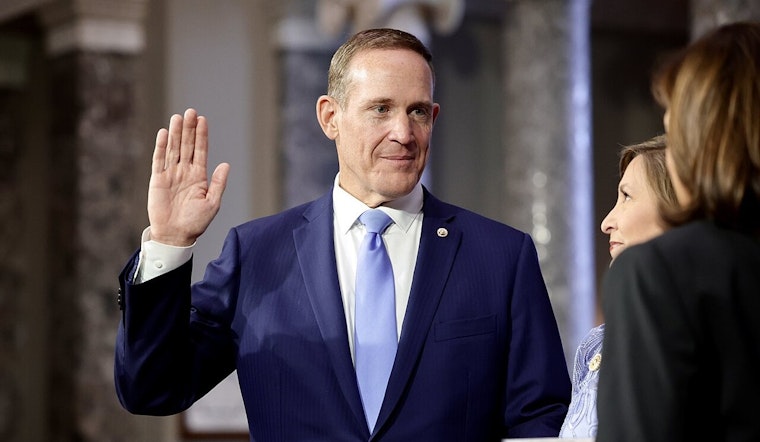
Sen. Ted Budd (R‑N.C.) and Rep. Mary Miller (R‑Ill.) are pushing a new federal crackdown in Washington that takes aim at one of the more sensitive corners of immigration and policing: local officers who are in the country unlawfully but carrying government‑issued guns.
Their proposal, the Stop Illegal Alien Cops Act, was rolled out Wednesday and is written to bar any government entity from issuing firearms or ammunition to an officer who is in the United States illegally. Budd has framed the move as closing a “loophole,” pointing to a string of recent immigration arrests involving people working or training in local law enforcement. Backers are billing it as a straightforward public safety fix, while some local officials and advocates say the real‑world cases are messier than the bill’s talking points.
What sponsors say
Budd and Miller say the bill would spell out that any officer who is an “illegal alien” and serves in an armed capacity is barred from possessing firearms or ammunition that come from a federal, state or local government. Budd argues that the change would “ensure illegal aliens working at local police departments are held to the same legal standard.”
According to Sen. Budd's office, several Republican senators, including Marsha Blackburn and John Cornyn, have already signed on in the Senate. Gun Owners of America and the National Shooting Sports Foundation are listed as endorsing the measure. Budd also promoted the rollout on X in a post tied to the bill’s introduction.
What the bill would change
The draft text would tweak federal firearms law in a fairly surgical way. It would amend Title 18 so that the existing prohibition on firearm possession by certain aliens extends explicitly to government‑issued weapons and ammunition. In practice, that would prevent police departments or other government entities from handing guns or ammo to officers who are unlawfully present in the country.
The text posted at Budd.senate.gov shows section 925(a)(1) being revised to fold specific subsections of section 922 into the statute’s “government use” provision. The bill carves out narrow exceptions, including for visiting foreign law enforcement personnel and other limited situations. Supporters describe it as narrowly tailored so that a government agency cannot effectively grant firearm possession to people whom federal law already lists as prohibited.
Existing law and legal questions
On paper, federal law already speaks to this. Under 18 U.S.C. § 922, an alien who is “illegally or unlawfully in the United States” is barred from shipping, transporting or possessing a firearm, a framework summarized by the Legal Information Institute. Courts and legal analysts have spent years arguing over what exactly counts as being “illegally or unlawfully” present, and how that language applies to different immigration categories.
Supporters of the Stop Illegal Alien Cops Act say their bill is meant to cut through some of that gray area in the specific context of government‑issued weapons. For readers wanting a deeper dive into the phrase’s history in court, the sponsors point to recent case analysis and judicial opinions that have parsed the statute’s wording.
Recent arrests that pushed the measure
The timing of the bill is no accident. It follows several headline‑grabbing arrests highlighted by federal immigration officials.
In Old Orchard Beach, Maine, Immigration and Customs Enforcement arrested a reserve police officer, saying he had overstayed his visa and tried to buy a firearm while serving with the department. The Associated Press reported that the local police chief called for an internal review after the arrest.
ICE also publicly pointed to a January arrest in New Orleans, where agents took a police recruit into custody. Federal officials said the recruit had an active deportation order and had been issued a department firearm, a case covered by Fox News.
In suburban Chicago, scrutiny fell on Hanover Park when federal agents detained an officer amid questions about his visa status. Village officials said they believed the officer’s hiring had been properly vetted, according to CBS Chicago.
Local pushback and nuance
Local chiefs and municipal leaders in those jurisdictions have not exactly embraced the federal narrative.
In Old Orchard Beach, the chief said the officer had been “cleared through federal checks,” as reported by The Associated Press, suggesting that standard vetting and background checks had been completed. In New Orleans, the police department publicly disputed parts of ICE’s account in statements covered by Fox News, underscoring how paperwork, immigration records and agency databases do not always line up neatly.
Budd has also cited California’s SB 960 in his pitch, but that law is narrower than some national rhetoric implies. The statute removed a blanket citizenship requirement and makes non‑citizens who are legally authorized to work eligible to apply for peace officer roles. It does not open the door to applicants who are in the country without authorization, according to LegiScan.
What comes next in Washington
The Stop Illegal Alien Cops Act has now been formally introduced, with its text posted online. Under standard Senate procedure, it is expected to be referred to a committee for review, hearings and potential amendments.
Supporters argue the bill simply closes an enforcement gap between immigration and gun laws. Critics caution that it could complicate hiring and training for local departments that already lean heavily on federal background checks, or that work in states with their own personnel rules and reforms.
Its future will hinge on what happens in committee and whether any bipartisan appetite emerges for editing federal firearms law in this particular, highly charged corner of the immigration debate.



