

























































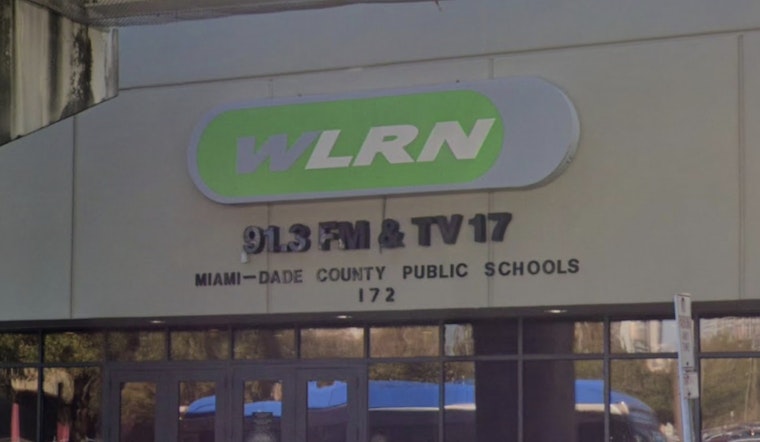
Miami’s flagship public radio station is in open revolt, with most of WLRN’s newsroom staff warning that the station’s future is in serious jeopardy after a tense internal meeting with the board’s top leader.
In a letter signed by a large share of employees, staffers say WLRN’s leadership has eroded trust inside the newsroom and mishandled concerns about a planned purchase of a West Palm Beach station. They are demanding an independent review of executive leadership and a formal transitional leadership plan, arguing that newsroom morale has taken a major hit as a high-stakes legal fight plays out over who controls the station.
The clash centers on South Florida Public Media Group (SFPMG) - the nonprofit that manages WLRN - and the Miami-Dade County Public Schools, which holds the station’s broadcast license. Staffers say the proposed station purchase risks draining attention, money and staffing from WLRN’s core reporting and community work in Miami.
According to Axios, the conflict escalated sharply at a recent internal meeting when Board Chair Richard Rampell reportedly referred to a senior school district official as “the superintendent’s Ghislaine Maxwell.” Staffers called the comparison offensive and unprofessional. In an interview with Axios, Rampell stood by the remark, said the official “deserved every bit of that accusation,” and made clear he has no plans to step down.
The broader standoff has big procedural and financial stakes. In a Feb. 18 letter, the FCC declined to block SFPMG’s license transfer for the planned West Palm station purchase, and the civil lawsuit brought by the school board is still active, according to reporting by Current. The school board’s complaint accuses SFPMG of using revenues that should support WLRN to bankroll the acquisition. SFPMG rejects that claim and argues the deal would expand service north of Miami.
SFPMG first unveiled plans in June 2025 to buy West Palm Beach’s The Flame 104.7, saying it would flip the commercial outlet to noncommercial programming and bring NPR news to under-served listeners in Palm Beach and Martin counties, per WLRN. Management says the purchase would create jobs and widen journalism coverage across South Florida. Staffers counter that donor dollars and organizational focus needed for the Miami newsroom could get diluted in the process.
What staff wants
In their letter, most signatories urged the board to order an “immediate and independent review of executive leadership,” adopt a clear transitional leadership plan and prioritize repairing relationships with the school district and community partners, according to Axios. Staff members say the Maxwell remark, paired with what they describe as a lack of transparency around financial decisions, has badly damaged trust throughout the newsroom.
Legal stakes
The legal fight zeroes in on whether SFPMG can tap revenues tied to an endowment and spectrum-lease income to finance the acquisition. The school board has asked a court to require that the buyer’s deposit be placed into the WLRN endowment, Current reports. The FCC’s move to process the license transfer does not settle the civil case; the parties are heading into mediation this week, with a court hearing scheduled beforehand.
What happens next
Both sides are set to meet for mediation this Thursday, Feb. 26, as the court weighs whether to send the dispute to the Complex Business Litigation Division. If the talks fall apart, the case could stretch into a lengthy court battle that would determine who calls the shots at WLRN and how its fundraising and lease income can be used in the years ahead. Staffers say they want a transparent review and a concrete plan to protect the station’s local journalism even if management continues to pursue regional expansion.
Why this matters
WLRN is one of South Florida’s primary sources of local news, and employees warn that leadership turmoil combined with a potential reshuffling of resources could weaken coverage of Miami neighborhoods and schools. The fight also highlights bigger questions for public media: how nonprofits that manage stations should balance deeply local missions with ambitions to grow across a region, and whose donors and assets take precedence when a station is overseen by an outside nonprofit rather than directly by the school district that holds its license.





