

























































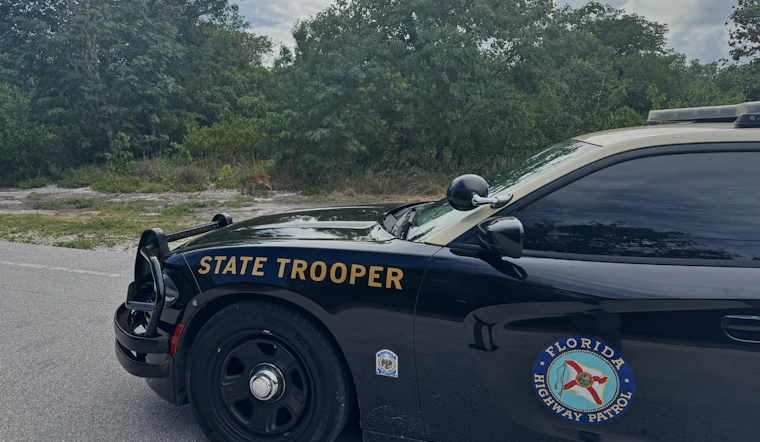
More than 100 traffic stops by a Florida Highway Patrol trooper assigned to Lake Worth Beach turned up a striking pattern: over nearly a year of tickets, not a single driver was marked as Hispanic. Community groups and researchers warn that kind of hole in race and ethnicity data can make it harder to see whether traffic enforcement is falling disproportionately on Latino residents.
Records show trooper rarely recorded ‘Hispanic’
Ticket records reviewed in Palm Beach County show Trooper John Petrofsky marked 87 drivers as white, 19 as Black and one as other across 107 cases, and did not designate anyone as Hispanic, according to WLRN. In several stops cited in that reporting, motorists with surnames such as Hernandez, Martinez and Rodriguez were logged as white.
One example in the records involves Jose Wilmer Hernandez Alvarez, pulled over on Sept. 23, 2025 for dark window tint. His traffic citation and arrest report both list him as white, according to WLRN.
Advocates and experts call for a review
Local immigrant advocates and policing researchers say that kind of pattern makes independent oversight a lot tougher. Josh Parker of the NYU Policing Project told WLRN that such numbers should be a red flag, saying it should prompt supervisors at Florida Highway Patrol to review the trooper’s stops.
Renata Bozzetto of the Florida Immigrant Coalition told the outlet that missing or skewed data could reflect poor training or, in a more troubling scenario, an effort to mask bias. Mariana Blanco of the Guatemalan Maya Center said residents have reported aggressive, immigration-focused patrols in the area, adding to community concern about who is being stopped and how those encounters are recorded.
How race and ethnicity get recorded
On Florida traffic citations, race is reduced to a single letter: W, B, I, H, A or O. That means an officer’s split-second visual judgment becomes the official record, according to the state’s uniform traffic citation manual, the Florida UTC manual.
Experts say that when law-enforcement records do not line up with how the U.S. Census measures race and Hispanic or Latino ethnicity, it is tough to make apples-to-apples comparisons. That matters because national datasets that track disparities in stops and arrests depend on accurate race and ethnicity fields. The Stanford Open Policing Project has assembled and standardized such data from agencies around the country and made it available for public analysis through Stanford.
Misclassification is a national problem
The issue in Palm Beach County echoes patterns uncovered elsewhere. Investigations have found departments that routinely listed drivers with Hispanic surnames as white, which can make racial gaps in traffic enforcement look much smaller than they really are. ProPublica documented that problem in Louisiana and highlighted similar concerns in Texas, and researchers say inconsistent ethnicity fields are a recurring obstacle to accountability.
The question has taken on new urgency in Florida as local participation in federal immigration enforcement under 287(g) has expanded. The federal agency explains the 287(g) partnership on its site, according to ICE.
Local incidents have already sparked outrage
Trooper Petrofsky has already drawn national attention after high-profile videos of immigration-related stops in Palm Beach County ricocheted across social media. A May 2, 2025 encounter recorded by a teenager drew intense scrutiny and nationwide coverage; The Guardian reported on the footage and the fallout that followed.
In a separate North Palm Beach stop in January 2026, a bystander was tased and Petrofsky was placed under supervisory review, according to local coverage. Florida Highway Patrol confirmed that review, WPTV reported.
What the state review shows — and does not
Florida Highway Patrol’s Office of Inspector General conducted a bias-based profiling review in 2020 that compared troopers’ traffic stops against county census figures, according to the agency’s annual report. The details of that work appear in the OIG’s 2019–20 annual report.
Advocates and reporters say the department’s current record-keeping practices make it hard to match law-enforcement entries with the way the Census counts Hispanic or Latino ethnicity. That mismatch can leave many Latino drivers effectively invisible in routine audits, even when they are being pulled over in significant numbers.
Legal implications
Florida Highway Patrol policy forbids bias-based profiling, and the inspector general’s review was explicitly intended to spot disparities in who gets stopped. Civil-rights attorneys caution that if race and ethnicity are systematically misclassified, those safeguards can fail quietly and allow harm to continue unchecked.
In places where misidentification has been documented, it has prompted calls for independent investigations and changes to how agencies collect and publish stop data. Reporting and audits in other states have shown how data gaps can kick off broader accountability efforts, as chronicled by ProPublica.
What to watch next
Community groups say they plan to press for an internal audit of traffic-stop records and for supervisors to scrutinize individual citations to see whether drivers’ ethnicity was miscoded or left out entirely. Researchers and advocates argue that standardized, rigorously audited data is essential to judging whether police are enforcing the law equitably and to rebuilding trust in neighborhoods that already feel targeted.





