

























































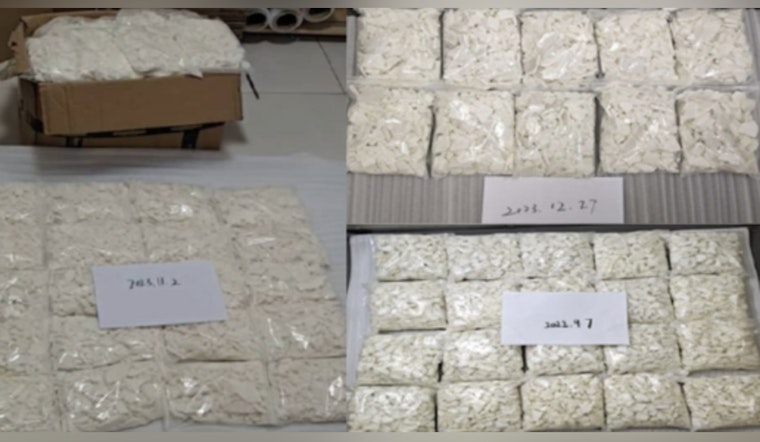
Federal prosecutors say a South Florida drug pipeline built on a powerful synthetic stimulant has just hit a legal wall. Terrell Jermaine Williams, 40, pleaded guilty Thursday in federal court to conspiring to import n‑isopropyl butylone, a potent synthetic stimulant often sold as “flakka,” from China for distribution in South Florida. According to court filings, the scheme moved novel cathinone shipments into the region between 2022 and 2025, and Williams now faces federal prison time if the court imposes statutory maximums on the counts to which he admitted.
Florida's Voice reports that the plea followed an investigation led by Homeland Security Investigations in Miami with assistance from HSI personnel in Guangzhou. Prosecutors say Williams coordinated with a China‑based supplier to bring N‑isopropyl butylone into South Florida between 2022 and 2025, and U.S. Attorney Jason A. Reding Quiñones described the narcotics as "powerful and unpredictable stimulants." The outlet notes that Williams faces up to 20 years in prison on each count he admitted to.
How Authorities Say The Import Ring Worked
Court documents reviewed by Florida's Voice indicate that Williams and the overseas supplier relied on a mobile messaging platform to coordinate shipments and to keep tabs on political conditions that might affect inspections. In one message cited in the filings, the distributor warned that "authorities were increasing inspections because 2024 was an election year." The same filings state that Chinese officials intercepted roughly 700 kilograms of the chemical in September 2025. The documents describe Homeland Security Investigations' offices in Miami and Guangzhou as central to the probe.
N‑Isopropyl Butylone And The Local Drug Picture
Forensic labs and public‑health researchers have flagged N‑isopropyl butylone as an emergent synthetic cathinone first identified in 2024 and increasingly detected in U.S. samples, particularly in Florida, according to CFSRE. Industry testing firms have reported that the compound's share of stimulant detections rose through 2025, suggesting it is replacing other scheduled cathinones in some markets, and Aegis Sciences' mid‑year data documented that shift. Officials say that trend complicates overdose investigations and emergency responses because the drug's potency and its interactions with fentanyl and other substances remain poorly understood.
Legal Consequences And What Comes Next
Williams’s guilty plea moves the case toward sentencing, and federal law treats importation and related conspiracy counts severely. A conviction under the Controlled Substances Import and Export Act can carry up to 20 years' imprisonment per count in many cases, depending on quantity and other factors, according to Cornell Law School. Prosecutors handled the case using tools tied to the Homeland Security Task Force framework that the government established under Executive Order 14159 to coordinate HSI, the FBI and U.S. Attorney offices on transnational criminal networks, an approach outlined by the FBI. A sentencing date has not yet been set in the Southern District of Florida.





