

























































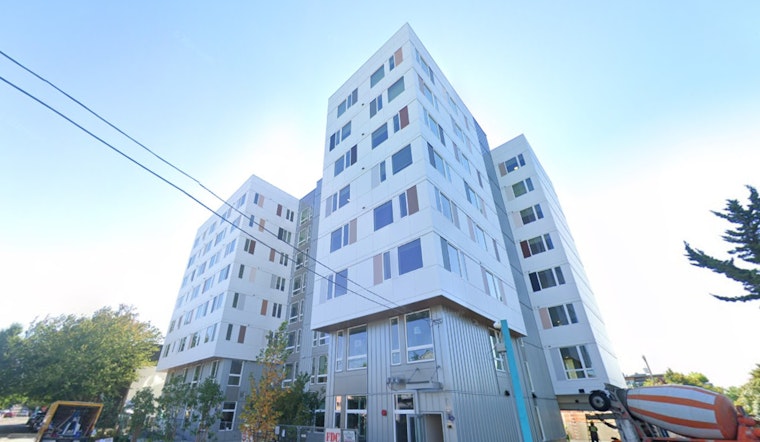
For the first time in more than two decades, Ballard is getting a sizable batch of new affordable apartments. A nonprofit developer has opened an eight-story building with 84 income-restricted homes that lean heavily toward family-sized units and on-site services, all aimed at keeping lower-income households rooted in a neighborhood where rents have been climbing fast. City and private partners describe the project as the opening move in a larger redevelopment tied to St. Luke’s Episcopal Church.
BRIDGE Housing Opens St. Luke's
BRIDGE Housing has opened St. Luke’s Apartments, an 84-unit affordable community built on church-owned land and described by officials as Ballard’s first new affordable housing development in more than 20 years, according to Affordable Housing Finance. The homes are reserved for households earning roughly 50-60% of area median income and range from studios to three-bedroom apartments. Developers and city officials say the building is specifically intended to serve families pushed around by rising rents and to pair those homes with services designed to help residents stay housed for the long haul.
What St. Luke's Offers
The eight-story building includes a mix of studios, one-, two- and three-bedroom apartments, along with a community room, bike storage, laundry rooms on multiple floors and a rooftop play area, per BRIDGE Housing. The property targets households at 50-60% of area median income and is set up for on-site resident services provided by local nonprofit FamilyWorks. Project partners say they prioritized accessibility, larger family units and bike-friendly features when shaping the design.
Financing and Services
The roughly $52.3 million price tag is being covered by a mix of public and private financing that includes the Seattle Office of Housing, Seattle Housing Authority, the Washington State Housing Finance Commission and J.P. Morgan, according to Affordable Housing Finance. UnitedHealth Group came in as one of the largest private equity investors and also contributed a grant to bolster on-site services provided by FamilyWorks. The development team says that combination of subsidies and private capital made it possible to reach deeper levels of affordability and fit more family-sized apartments on a relatively small site.
Part of a larger redevelopment
St. Luke’s Apartments serves as the affordable "east" building in a two-structure redevelopment that will ultimately add roughly 286 apartments on the block when paired with a market-rate west building and a new church space, according to city project records from the Seattle Department of Construction & Inspections. The west building is planned as a market-rate tower with a share of units restricted through the city’s Multifamily Tax Exemption program. Overall plans call for shared underground parking and a public courtyard that will face Ballard Commons Park. City documents note that the development team brought early designs to the West Design Review Board and carried out extensive outreach with nearby residents during the entitlement process.
Residents and reactions
Families have already started moving into the building, according to neighbors and the church, and the congregation reports that it helped furnish apartments and cover application fees for incoming tenants, per a project update from St. Luke’s Episcopal Church. The church highlighted stories of households relocating from unstable living situations into new three-bedroom units and tied the move-ins to its ongoing capital campaign that supports the broader redevelopment. Local service providers and the development team say these early resident stories show the project is already starting to stabilize families in Ballard.
Design and project team
The building was designed by VIA Architects and constructed by Exxel Pacific, with BRIDGE Housing developing and managing the affordable component, per the developer’s project page. Security Properties is leading development of the adjacent market-rate building, and the team says the two projects were coordinated to preserve an existing grove of trees and create a shared greenway. City records add that the team worked with staff to tweak parking and unit layouts in order to fit more family-sized homes onto a constrained site.
Leasing and management
St. Luke’s Apartments are professionally managed and listed by Avenue5 Residential, and the property’s leasing site currently shows units available along with a range of income-restricted rents, according to the official community site. The leasing materials also outline community amenities and describe the on-site services partnership with FamilyWorks, which is intended to support residents with benefits access, job training and family support. Prospective tenants are directed to the official community website for current income limits, eligibility rules and application details.
Why it matters for Ballard
In a neighborhood dominated by market-rate construction and steadily rising rents, St. Luke’s Apartments represents an unusually large injection of family-sized affordable homes. City planning documents note that the project was enabled in part by zoning provisions that allow religious organizations to build bigger projects when they commit to permanent affordability and other public benefits, according to records from the Seattle Department of Construction & Inspections. Local housing advocates see the combination of church-owned land, nonprofit development and public financing as a practical template for delivering deeper affordability in high-demand areas like Ballard.
What’s next
Phase II, the market-rate west building that will also house a new church on its ground floor, remains in design and is expected to start construction in 2026 or early 2027, the congregation reports in a project update. That second building is slated to add roughly 200 market-rate units, with a portion of apartments reserved under the city’s Multifamily Tax Exemption program, according to spstlukeshousing.com. Developers say they plan to keep up community outreach as permitting advances and intend to shape the second phase around the needs of Ballard families and the church’s long-term ministry.




