

























































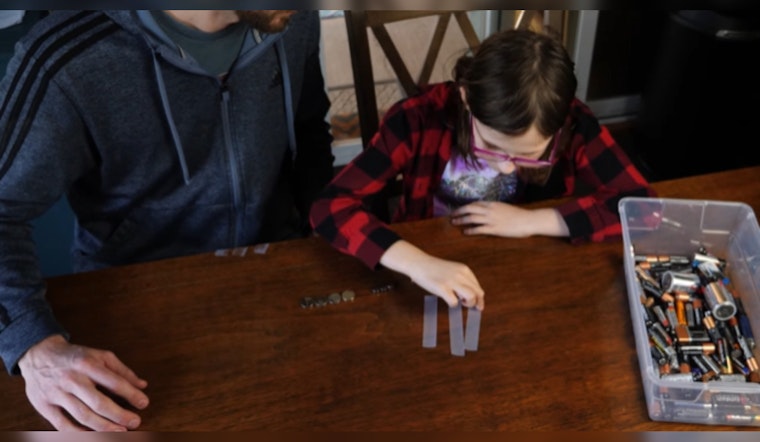
Clackamas County is asking residents to handle old household batteries with a bit more care after a few recycling truck fires this month put crews on edge. In a recent Facebook Reel, the county said simple prep work at home can help prevent batteries from sparking in collection trucks.
The county’s guidance boils down to three quick steps: tape the terminals on all batteries except standard alkaline, drop the taped batteries into a clear one-quart zip-top bag, then place that bag on top of your glass recycling bin for pickup. Officials say those small steps are meant to protect truck drivers, first responders and recycling facilities from fires that do not need to happen.
How To Get Batteries Ready For Pickup
The county’s curbside rules are straightforward: tape the ends of every battery except alkaline, seal them together in a clear one-quart zip-top bag, and set that bag on top of your glass recycling bin on collection day. Residents are asked to put out only one battery bag per pickup and to roll the glass bin to the curb only when it is at least half full.
Those precautions are designed to keep loose cells from touching, shorting out and sparking inside trucks, a risk highlighted in the county’s Facebook Reel.
Who Can Recycle Batteries Curbside
The curbside battery option is available to single-family homes and small multiunit buildings, including duplexes, triplexes and fourplexes. People who live in larger apartment buildings are asked to use designated battery drop-off sites instead.
Nearby jurisdictions, including Portland, launched similar curbside battery programs last year to cut down on fires in collection trucks and at material recovery facilities. For residents who do not have a glass recycling bin, Clackamas County advises setting a clearly labeled battery bag next to your other recycling or taking batteries to a drop-off site, as outlined by the City of Portland.
Why It Matters
Lithium-ion and other rechargeable batteries can ignite if their terminals touch or if a cell is crushed in a truck compactor. A national review of lithium-ion battery fires in the waste stream documents hundreds of incidents that have damaged facilities and disrupted service, according to a U.S. EPA analysis.
That pattern is a big reason local agencies are tightening up battery-handling rules and pushing for separate collection. Safety guidance also stresses that damaged, bulging or leaking batteries should never go in curbside recycling and instead must be taken to a hazardous waste facility, according to the same U.S. EPA report.
Drop-Off Options And Extra Safety Tips
For anyone who prefers drop-off to curbside, the Metro South Household Hazardous Waste facility in Oregon City accepts household batteries at no charge, and Metro’s Recycling Information Center can help residents find additional nearby locations.
The county also offers short public service announcements and a step-by-step video walking residents through how to prep batteries correctly, as detailed by Clackamas County. For broader guidance on recycling and hazardous items, the Oregon Department of Environmental Quality runs a Recycle Right portal with local tips.
Where To Learn More
Residents who are not sure whether a battery belongs in curbside collection can call Metro’s Recycling Information Center at 503-234-3000 for live help, or check the state’s Recycle Right resources for more details.
Clackamas County’s battery-recycling web page, along with the linked video, carries the most current curbside instructions for county residents.





