

























































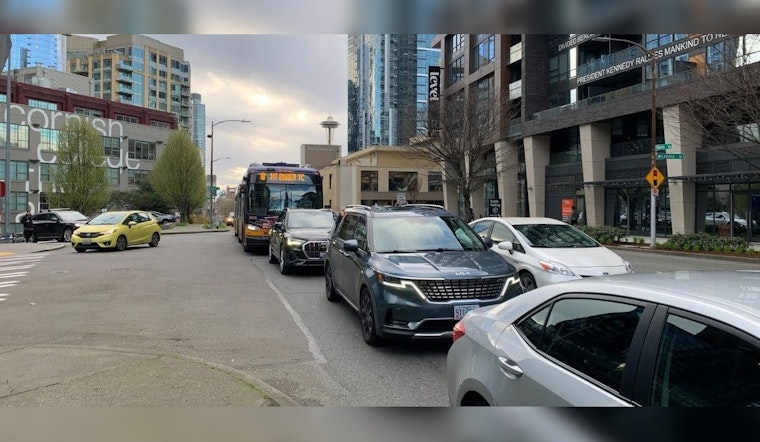
Denny Way, one of Seattle’s most notoriously clogged corridors, is about to get a transit shake-up. The city will convert a general-purpose lane into a bus-only lane in a bid to speed up the chronically late Route 8, with Mayor Katie Wilson and the Seattle Department of Transportation set to roll out the details at a news conference on Wednesday, April 22, 2026, at 1 p.m. The move targets one of Seattle’s key east–west links through South Lake Union, Belltown and Capitol Hill.
Wilson’s administration directed SDOT to design and install at least one dedicated bus lane on Denny Way to improve on-time performance, as laid out in City of Seattle Executive Order 2026-01. The document notes that Route 8 carries roughly 7,000 daily riders and that eastbound afternoon trips in July 2025 were on time only about 31% of the time, a stat that captures just how unreliable the route has become.
Phase 1 details and schedule
SDOT says Phase 1 - West will add a southbound business-access-and-transit (BAT) lane on Queen Anne Ave N and an eastbound BAT lane on Denny Way between Queen Anne Ave N and 2nd Ave. The plan also includes a bus queue-jump signal at 2nd Ave. Crews are expected to install the changes over a single weekend in early May, turning a normal traffic weekend into a quick construction sprint.
For drivers, the most noticeable change will be the loss of one westbound general-purpose lane between 2nd Ave and Queen Anne Ave N. The city will keep two eastbound general-purpose lanes in place, and SDOT says it will monitor travel times and traffic patterns once the new layout is live, according to the Seattle Department of Transportation.
Riders and drivers react
Bus riders along the corridor did not need a data dashboard to describe the problem. Many told reporters they call the 8 “Route Late” and say buses can be “usually 15 to 20 minutes late,” especially when Denny clogs up. At the same time, the street carries heavy car traffic; KOMO reports the corridor handles more than 20,000 vehicles a day, citing city figures.
King County Metro told local reporters that the new bus-priority features could cut roughly one to two minutes from trips for Route 8 riders. It is not a dramatic time savings on its own, but Metro is framing the change as a first step that could set up additional improvements if the pilot proves successful, KOMO adds.
What to watch for next
SDOT says it will study the corridor before and after the changes go in, then consider adjusting the design based on how traffic, buses and delays actually play out. Phase 2, which would extend east of 2nd Ave toward Stewart St, is still in design, with more specifics yet to come, according to the agency’s project page.
The city is pitching the Denny Way work as a relatively quick, low-cost test that can deliver measurable benefits for thousands of daily bus riders, even as some drivers and nearby residents worry that losing a lane could push more congestion into surrounding streets. Seattle is about to find out whether a little red paint for buses can make “Route Late” live up to its schedule.





