

























































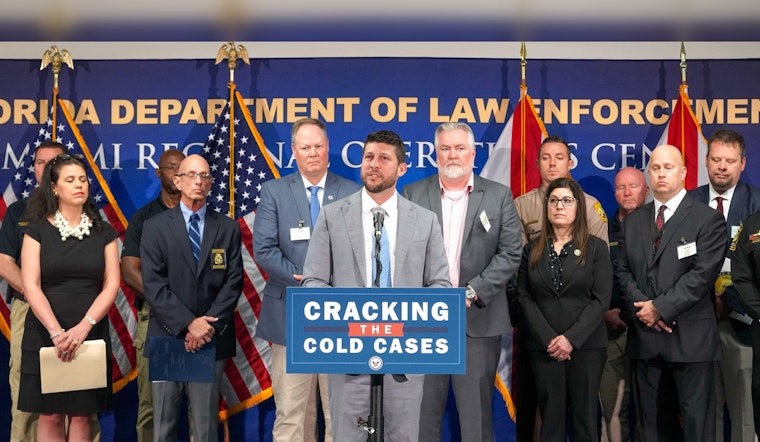
Florida’s attorney general is cracking open the state’s oldest homicide files, rolling out a long-haul push to match dusty evidence with cutting-edge DNA science. The Office of Statewide Prosecution is partnering with Othram, a private forensic laboratory, to re-examine stored biological evidence and chase down new leads in cases that have sat unsolved for decades.
Attorney General James Uthmeier framed the effort as a statewide offensive on cold cases, according to CBS12. State officials say Florida is sitting on roughly 21,000 unsolved homicides and nearly 900 cases involving unidentified remains. Uthmeier said the new approach is aimed squarely at families who have been waiting years, and in many instances generations, for answers.
The rollout starts small but symbolically heavy. The first wave will focus on three multi-circuit investigations: a 1970s case tied to Broward and Miami-Dade, a late 2000s double homicide in Miami Gardens, and an early 1980s killing in Central Florida, according to CBS12. “These cases remained unsolved not because the evidence wasn’t there, but because the technology didn’t exist to interpret it,” Othram founder David Mittelman said in the announcement. The attorney general’s office added that once the program is running, it is expected to expand to serial sexual battery investigations where DNA evidence might still be sitting in storage.
How the testing works
According to Othram, the lab leans on its Forensic-Grade Genome Sequencing and proprietary genealogy tools to build detailed DNA profiles out of degraded, mixed or otherwise difficult samples that standard STR testing does not always crack. The Florida Department of Law Enforcement will screen potential evidence, coordinate the lab work with investigative follow-up, and decide which cases move to the Office of Statewide Prosecution as the effort spreads across judicial circuits. The idea is that even when there is no known suspect, pairing lab-grade sequencing with genealogical research can still generate solid investigative leads.
Local successes that set the stage
Florida law enforcement has already seen what this toolkit can do on a smaller scale. In January, FDLE announced that advanced genetic genealogy, used in partnership with Othram, helped identify human remains recovered after Hurricane Irma. That work led to a confirmed identification and notification of next of kin. "FDLE’s Key West Field Office and Forensic Services turned over every stone to identify Mr. Schlake," FDLE Commissioner Mark Glass said in the agency’s news release.
County agencies have logged similar wins, from Palm Beach County to Hillsborough, where local investigators have used the same mix of lab work and genealogy to move long-stalled cases forward. Officials say those local breakthroughs are exactly what this statewide program is trying to reproduce on a much larger scale, pointing to a recent report on a Boca Raton cold-case breakthrough as one example.
Privacy, oversight and the law
Florida has been trying to build a legal framework around this kind of DNA sleuthing even as it leans into the technology. Legislative analyses and bills have created a grant program to help fund forensic genealogy work and designated investigative genealogy materials as confidential, with limited rules for when and how they can be disclosed in court, according to state bill analyses. Privacy advocates and some experts have continued to push for clearer guardrails and tighter vendor requirements, while industry coverage has warned that uneven policies and unreliable funding can blunt how widely the tools are used. The Florida Senate analysis and reporting in Forensic Magazine both highlight the balance lawmakers tried to strike between investigative power and genetic privacy.
For now, state officials say they are keeping details of the three active investigations under wraps while evidence is reviewed and leads are chased. They stress that the measure of success will be identifications and workable leads, not splashy headlines. The longer-term goal, they say, is an organized statewide pipeline that any Florida agency can use whenever biological evidence still exists and might finally give families the answers they have been missing.





