

























































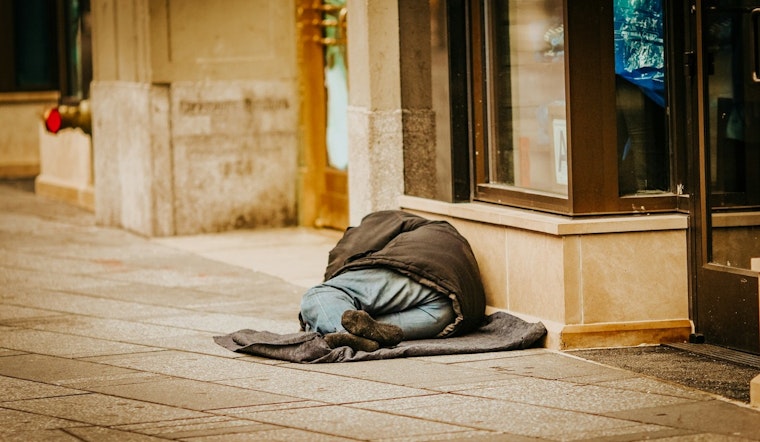
State lawmakers in Springfield are deep into a high-stakes fight over when cities and counties can ticket or jail people who sleep, eat or keep their belongings on public land. Backers say the proposal is about stopping the criminalization of basic survival. Critics warn it could leave local officials powerless when parks and sidewalks feel unsafe. Civil-rights groups, county associations and neighborhood coalitions are all wading in as the bill moves through committee.
What the bill would do
House Bill 1429 would rewrite how Illinois handles unsheltered homelessness by amending the state’s Bill of Rights for the Homeless. The measure would bar the state or any local government from imposing fines or criminal penalties on people experiencing unsheltered homelessness for a broad list of “life-sustaining activities,” including sleeping, resting, eating and storing personal property, according to the bill text.
The bill would also create an affirmative “necessity” defense in criminal prosecutions, require outreach and seven days’ notice before enforcement actions in non-emergencies, and limit home-rule authority in this area. Introduced by Rep. Kevin John Olickal, HB1429 presents itself as an effort to safeguard basic rights while still allowing narrow public-safety exceptions, per the Illinois General Assembly.
Advocates say criminal penalties backfire
Homelessness advocates argue that tickets and fines do not produce housing, and that they often do the opposite by clogging up background checks with citations or arrests that landlords and employers can see. The Chicago Coalition to End Homelessness and partner groups have pushed for a statewide fix, pointing to dozens of local ordinances across Illinois that penalize outdoor survival activities and, in their view, stack additional barriers on people already struggling to get housed.
Supporters also highlight provisions that force outreach and service referrals before any enforcement, which they frame as a more humane, evidence-based way to handle encampments than a steady drumbeat of tickets, according to the Chicago Coalition to End Homelessness.
Local leaders and neighbors push back
On the other side, county officials and some neighborhood groups say HB1429 would preempt local decision-making and drop unfunded mandates on cities and counties. In formal testimony, the Illinois State Association of Counties warned of an “erosion of local control and preemption of home rule,” arguing that the bill could create legal gray areas and new liability for local governments.
Neighbors who have spent years pressing officials to clear large encampments describe fires, discarded needles and trash as problems that require fast responses from local agencies. Coverage has repeatedly flagged Gompers Park on the Northwest Side as a flashpoint in that debate, with residents and officials clashing over encampments and park use, according to Block Club Chicago.
Why the timing matters
The measure is landing just after a 2024 U.S. Supreme Court decision that made it easier for cities to enforce anti-camping and anti-sleeping ordinances. That ruling prompted advocates in Illinois to look for a uniform statewide response rather than leaving the issue entirely to local governments.
The bill drew fresh attention this week at a House Housing Committee hearing in Springfield on Wednesday, where lawmakers took testimony and signaled that amendments are likely. Those two developments: the high-court decision and the committee hearing, help explain why state leaders are suddenly rethinking how Illinois handles encampments.
Legal analysts have described the Supreme Court opinion as a shift in the constitutional ground under homelessness enforcement. Background on that ruling is available in the U.S. Supreme Court opinion. Details on the hearing and witness slips are posted by the Illinois General Assembly.
Housing shortage fuels the policy clash
Advocates stress that the core issue is not just enforcement policy, but the lack of deeply affordable homes. A recent report co-released by Housing Action Illinois and the National Low Income Housing Coalition found that the Chicago metro area is short roughly 224,000 affordable rental homes for its lowest-income renters. That gap is frequently cited as a major driver of encampments and street homelessness, according to Housing Action Illinois.
At the same time, the City of Chicago has rolled out a five-year homelessness blueprint that leans on ramping up housing production and streamlining development approvals. The plan, however, leaves open questions about long-term, dedicated funding to actually pay for those solutions, per UChicago Urban Labs.
Legal implications
If lawmakers pass HB1429, its “necessity” defense and protections for “life-sustaining activities” are widely expected to spark new legal tests. Courts would likely be asked to sort out where protected survival behavior ends and public-safety threats begin.
Opponents warn that the bill’s broad language could fuel expensive lawsuits and push local governments to provide services they are not funded to deliver. Supporters counter that taking criminal penalties off the table makes it easier for people to connect with housing and services, and avoids saddling already vulnerable residents with records that block them from getting rehoused.
What’s next
HB1429 could still change as it works through committee and the Rules process, and both sides are already lobbying hard. Statehouse coverage and policy briefs suggest the bill is on track to stay a top-tier fight this spring, as lawmakers sort through tradeoffs among enforcement, public safety and housing investments, according to reporting from Axios Chicago.
For Chicago neighborhoods and counties across Illinois, the outcome will reach far beyond any single encampment. Lawmakers are effectively deciding whether the state should prioritize sharply limiting criminal penalties for people surviving outdoors, or leave broader authority in local hands to clear encampments while still pushing, at least on paper, for more housing and services. Expect more testimony, more amendments and a fair amount of partisan sparring before they land on an answer.



