

























































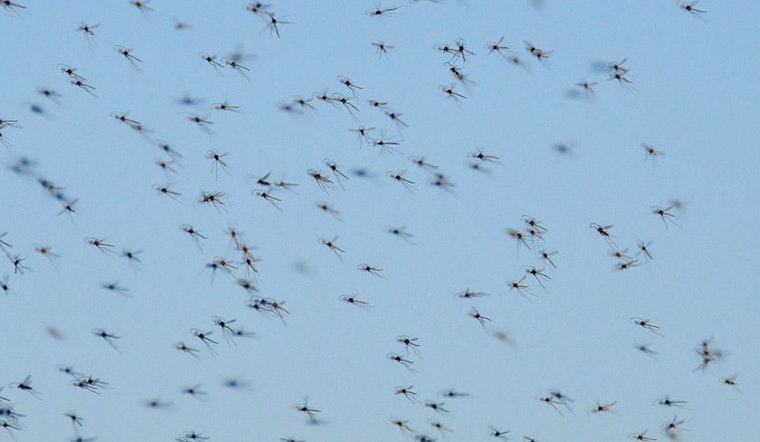
Parts of Chicago’s lakefront turned into a moving wall of insects on Thursday, as massive swarms of tiny flies descended on paths, parks, and nearby roads. Runners, dog walkers, and drivers were suddenly swatting through thick clouds of gnat-sized bugs, while videos on social media showed dark columns of insects rising like smoke and coating trees, windows, and windshields. For many people out for an evening stroll along the water, the scene was enough to cut plans short.
The outbreak was caught on camera and reported on Thursday by FOX 32 Chicago, which identified the insects as seasonal midges clustering along sections of the lakefront. In the station’s footage, dense vertical plumes drift with the breeze and gather around lighted structures, turning streetlamps and building facades into bug magnets. Viewers along the shoreline shared similar clips and photos as the moving cloud pushed a short distance inland.
What The Swarms Are And Why They Happen
Entomologists say the bugs are non-biting chironomid midges, often called lake flies, that spend nearly their entire lives underwater as larvae before emerging in spring to mate and lay eggs, as reported by the Milwaukee Journal Sentinel. P.J. Liesch of the UW–Madison Insect Diagnostic Lab told the Sentinel, "The adults themselves are short lived," explaining that warming lake temperatures trigger many larvae to develop and emerge at the same time along long stretches of shoreline. Males gather first in swooping mating swarms, and females then fly in to join the masses.
How Long They Stick Around And Whether They Are Dangerous
Researchers note that adult midges typically survive only a few days and that the biggest bursts usually peak in late spring before tapering off. The swarms can seem to appear out of nowhere, yet they are a routine part of the lake’s seasonal rhythm, as outlined in scientific literature from the Journal of Plant Ecology. The adults do not bite or spread disease, but once they start dying off, their bodies can leave slick residues and messy piles that create headaches for sidewalks, cars, and patios. Because the flies are weak fliers, changing winds and weather usually scatter and thin out the swarms within days.
How To Cut Down On The Nuisance
For homes and businesses near the shore, simple tweaks can help keep the worst of the bugs at bay. Experts suggest turning off or dimming bright white exterior lights at night, closing shades, and using fans to keep air moving around entryways, all tactics recommended to make properties less attractive to midges. Spraying insecticides is considered ineffective and is not recommended, since the event is short-lived and the adults are harmless, according to the Milwaukee Journal Sentinel. For most people, regular windshield wipes and quick cleanups of outdoor furniture are enough to ride out the seasonal surge.
Why The Swarm Matters For The Lake
While the swarms are irritating for anyone trying to enjoy the lakefront, they carry real weight for the ecosystem. Research in the Journal of Plant Ecology describes how mass midge emergences act as a seasonal food pulse for fish, birds, and other wildlife and can even deliver nutrients to shoreline plants once the insects die and decompose. That burst of insect biomass helps sustain forage fish and the birds and bats that prey on them, showing that the unnerving clouds of bugs are part of a larger Great Lakes cycle. For city beachgoers, the midges are a short-term annoyance, but for the lake, they amount to a yearly windfall.
Experts and local coverage indicate that numbers should begin to drop as temperatures shift and winds change, with most emergencies easing within a few days to a couple of weeks, though stubborn pockets can hang on longer. If swarms continue or create hazards for traffic or public spaces, local crews and park staff will move in to clear affected areas as needed, according to reporting by FOX 32 Chicago.





.jpg)