

























































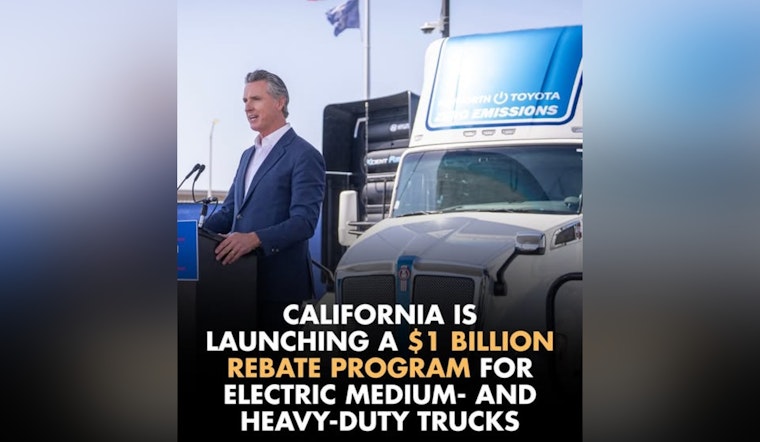
Governor Gavin Newsom is dangling a massive new carrot in front of California truck fleets: a $1 billion rebate program to nudge diesel rigs off the road and electric trucks into their spots. The plan promises steep, point-of-sale discounts for everything from drayage trucks and delivery vans to box trucks and full-size electric semis. State officials are pitching it as both a lifeline for communities choked by freight pollution and a play to keep clean-vehicle manufacturing and jobs in the United States. Applications are open now, with authorized dealers set to start applying rebates at the time of purchase on June 26, 2026, using revenue from California's Low Carbon Fuel Standard to chip away at steep upfront costs.
Newsom’s announcement and the dollars behind it
In a press release from the Governor’s Office, Newsom labeled the California Clean Fuel Reward (CCFR) a utility-administered, point-of-sale rebate funded by Low Carbon Fuel Standard revenue. Roughly $250 million is expected to be available in 2026, with more than $1 billion projected through 2030. The release says rebate levels will depend on vehicle class, starting at about $7,500 per truck and running up to roughly $120,000 for the heaviest electric semis, with retailers scheduled to begin applying the discounts on June 26. Newsom cast the program as part of a broader effort to slash diesel pollution and to defend American leadership in clean-vehicle technology.
How the rebates will be delivered
Program retail guidance spells out how authorized dealers and fleet retailers will file claims and get reimbursed, along with eligibility rules, vehicle classes, and per-unit caps. According to those materials, the point-of-sale setup is designed to spare buyers the usual waitlist drama by giving them an instant discount while administrators settle up with dealers afterward. The CCFR is built to cover a wide range of commercial vehicles, from Class 2b delivery vans all the way to Class 8 semis, each with its own caps, limitations, and operating rules.
It builds on existing truck incentives
The new rebate stacks on top of California's long-running truck incentive programs, including the Hybrid and Zero-Emission Truck and Bus Voucher Incentive Project (HVIP). The California Air Resources Board reports that HVIP has already delivered more than $1 billion in funding and helped deploy over 11,600 clean trucks and buses across the state. CARB says those vehicles have collectively logged about 181 million miles, with earlier incentives concentrating on smaller fleets and drayage operators in the neighborhoods hit hardest by diesel exhaust. Officials say the point-of-sale CCFR is meant to complement, not replace, existing vouchers, grants, and local rebate pools run by air districts and regional agencies.
Critics push back
Not everyone is cheering the electric truck cash splash. Conservative commentators and some industry voices have slammed the move as a pricey subsidy that props up favored technology instead of fixing underlying cost and infrastructure headaches. As reported by the New York Post, critics argue that heavy-duty electric trucks "still cannot compete economically on their own merits" and describe the package as a taxpayer giveaway. Others focus on the policy design itself, warning that broad incentives can misdirect limited public dollars without firm guarantees on supply chains or charging buildout, a concern raised in commentary from the Hoover Institution.
Practical hurdles remain for fleets
On the ground, fleet operators and utilities warn that rebates are only one piece of a much bigger puzzle. Long lead times for certain electric truck models, the need for high-power depot charging, and large on-site grid upgrades all loom as major obstacles. The California Energy Commission's Clean Transportation Program work and its recent investment plan updates highlight targeted infrastructure spending and close coordination with utilities as essential, not optional, partners to any vehicle subsidy. Industry analysts say the new rebates will take some sting out of sticker shock, but fleets still need predictable delivery timelines, detailed charging strategies, and trained staff if they are going to make the economics of electrification pencil out.
Bottom line
State officials argue that the CCFR is built to push cleaner trucks into the communities that have borne the brunt of diesel pollution, while keeping California at the sharp end of the clean transportation market. The Governor’s Office is selling the program as both environmental policy and industrial strategy, and the rollout will be closely watched by budget hawks, trucking companies, and residents who expect not just cleaner air but visible progress on charging infrastructure and jobs. With dealers able to start applying point-of-sale rebates on June 26, the next stretch will reveal whether the billion-dollar promise turns into electric trucks on the road or just fresh fuel for political arguments.





