

























































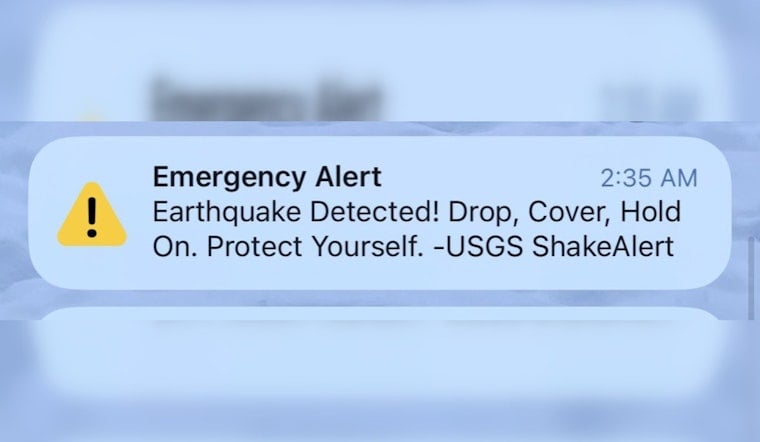
Nevada is racing to bring the West Coast's ShakeAlert earthquake early warning system into the Silver State, a move scientists say could give residents those precious few seconds to brace before the ground starts to move. The plan would link state seismologists with federal partners to design a rollout that works for both packed urban corridors and far-flung industrial sites.
As reported by KSNV, Christie Rowe, director of the Nevada Seismological Laboratory, said in a news release that the lab is “working closely with the U.S. Geological Survey on an implementation plan to bring ShakeAlert to Nevada.” KSNV also noted that some people in northern Nevada received a ShakeAlert cellphone notification about an earthquake in Mendocino County on a recent Wednesday morning, a reminder that alert zones do not stop at state borders.
Federal money cleared earlier this year helped set the table. Rep. Mark Amodei's press office announced the inclusion of $34.85 million in appropriations to expand ShakeAlert into Nevada and directed the U.S. Geological Survey to develop a technical implementation plan, according to GovTech.
How ShakeAlert works
ShakeAlert detects the first, fast-moving seismic waves near an earthquake's source and uses rapid-fire algorithms to estimate the location and magnitude. It then pushes alerts to phones and partnered systems so people and infrastructure can take protective action, according to ShakeAlert. It is not fortune-telling so much as ultra-quick number crunching.
Rowe told KSNV that "ShakeAlert makes an estimate of earthquake location and magnitude in about 3 seconds, so there is some tradeoff between accuracy and speed," adding that she would rather get a notification and later find out the quake was too distant to matter than miss a warning that could make a difference.
Why Nevada
Nevada regularly ranks among the nation's most seismically active states, commonly third after Alaska and California, and its maze-like Basin and Range fault system means even moderate quakes can ripple across a wide area, according to SFGATE. That status is not just a trivia point for geology buffs.
Recent jolts have driven the point home. A June 4 Las Vegas-area event was cataloged by monitoring centers including the Southern California Seismic Network. Earlier, a magnitude 5.7 near Silver Springs in April sent strong shaking across northern Nevada and into California, as covered in the Silver Springs shockwave report.
Rollout and concerns
Officials emphasize that Nevada's ShakeAlert expansion will not flip on overnight. The effort will require testing, upgrades to seismic stations and extensive community outreach before broad public alerting goes live. Along the way, agencies are keeping a close eye on system reliability.
The U.S. Geological Survey has been investigating an errant ShakeAlert message that briefly reported a magnitude 5.9 event near the Carson City area in December 2025 before removing the entry, a glitch that officials say underscores the need for careful calibration and tight quality control.
What residents and businesses should expect
If ShakeAlert is rolled out statewide, messages could be delivered to phones and to licensed partners that can trigger automated responses such as slowing trains, pausing industrial systems or alerting hospitals, tools the program highlights as ways to reduce harm, per ShakeAlert. The system is designed for seconds to tens of seconds of warning, not long lead times, so it is more of a head start than a heads-up days in advance.
Emergency planners still urge residents to be ready to respond on their own and to "drop, cover and hold on" when the shaking actually starts. ShakeAlert might buy time to act, they say, but it does not replace basic preparedness.
State and federal officials plan to keep gathering technical data and public feedback as they shape Nevada's implementation plan, and no firm date has been set for statewide alerts. For now, seismologists are urging Nevadans to treat the recent shaking as a nudge to revisit household emergency plans, check supplies and keep an eye out for official updates as the program moves forward.





