

























































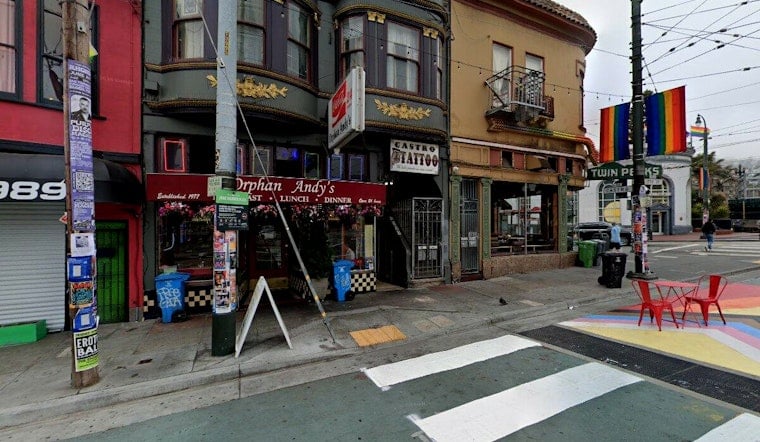
Editor's Note: This article has been updated to reflect that Orphan Andy's reopened on June 4, 2026, after addressing the health violations.
Orphan Andy's, the Castro's beloved 24-hour diner and one of San Francisco's last great late-night refuges, was ordered closed by city health inspectors over a cockroach infestation on June 3, 2026, but reopened the following day after addressing the violations. The Department of Public Health suspended the diner's permit and posted a CLOSED placard during a routine inspection on June 3, 2026, after an inspector documented fast-moving cockroaches "in all life stages" beneath the three-compartment sink in the kitchen and under the dish machine in the back of house and storage area — along with standing sewage water found in a clogged floor sink. The restaurant immediately contacted a pest control service and addressed the violations, reopening on June 4, 2026.
For nearly half a century, the little diner at 3991 17th Street has been where the Castro lands after last call — red vinyl booths, neon glow, chicken-fried steak smothered in gravy at 2 a.m. A closure placard on that particular door, beneath the neighborhood's landmarked rainbow flag, hits different than most.
What Inspectors Found
The inspection, conducted by SFDPH inspector Luz Brown between 10 and 11 a.m., triggered an immediate health permit suspension under the California Health and Safety Code. The phrase "all life stages" is the report's most alarming detail — eggs, nymphs, and adults together indicate an established, breeding population rather than a few stray roaches that wandered in. The infestation was concentrated beneath the dishwashing equipment, in cracks and crevices the inspector ordered sealed.
The report also documented a floor sink at the three-compartment sink clogged with standing sewage water — corrected on site when the drain was cleared — plus grease accumulation along the cook's line and on the kitchen's floors and walls, and gaps and holes in need of vermin-proofing. The prescribed fix is telling in its rigor: the diner must sign a pest control contract calling for weekly treatments for the first month, then twice-monthly treatments for three more months, followed by monthly service — a remediation schedule that signals the department expects this to take sustained effort, not a one-time spray. The closure was received and signed for by co-owner Bill Pung himself.
A Castro Institution at a Fragile Moment
The timing could hardly be worse. Orphan Andy's has been listed for sale since March 2025, when its married co-owners — Pung and Dennis Ziebell, who opened the diner in 1977 and live in the apartment upstairs — announced their retirement after 48 years. Hoodline reported at the time that the 36-seat institution was listed for $250,000, with interested buyers pledging to keep the name, the employees, and everything else exactly as it is. More than a year later, no sale has been announced — and the permit holder on this week's closure report is still Orphan Andy's Inc., with Pung receiving the inspector's paperwork. A health closure now lands squarely in the middle of that sale process, becoming part of the public record any prospective buyer will review.
The diner's story is woven into the Castro's. Ziebell, who hitchhiked to San Francisco from Nebraska in the 1970s and was himself an orphan later adopted, named the restaurant after the bygone Andy's Donuts, the 24-hour shop once frequented by Harvey Milk, as he recounted in a Hoodline profile tracing how the couple's relationship and the restaurant grew up together over four decades. Sitting at Jane Warner Plaza next door to the landmark Twin Peaks Tavern, Orphan Andy's has fed generations through the disco era, the AIDS crisis, the tech booms, and the pandemic — a history its owners have tracked through the neighborhood's own, as reported by the San Francisco Standard.
The Strain Was Already Showing
An honest reading of this closure can't ignore the pressures that preceded it. The Standard reported that Orphan Andy's had already trimmed its famous round-the-clock schedule on weekdays because late-night business could no longer support it, amid declining Castro foot traffic, the prolonged renovation closure of the Castro Theatre, and a wave of nearby losses including Chadwick's and Copas. The diner survived the pandemic on government aid and the loyalty of regulars. Two owners in their late sixties and seventies, ready to retire, running a 1,374-square-foot kitchen that has operated more or less continuously since the Carter administration — grease accumulation and aging, unsealed walls are the predictable wear of that marathon, and the inspection report reads like a building showing its age as much as a kitchen showing neglect.
The closure also adds a storied name to San Francisco's relentless drumbeat of vermin-related shutdowns. Just last week, Chinatown's century-old Far East Cafe was ordered closed over a rodent infestation, and in January, inspectors cited a major rodent problem at the Newsom-linked Balboa Cafe, giving the Cow Hollow institution one week to fix it. Old buildings, dense blocks, and tightened state restrictions on rodenticides have made pest pressure a citywide story — and the city's oldest, most beloved kitchens are proving the most vulnerable chapter of it.
The Castro has lost too many of its anchors lately to be casual about this one. The swift resolution of the health violations and the diner's quick return to service demonstrates the owners' commitment to maintaining the institution that has served the neighborhood for nearly five decades.



