

























































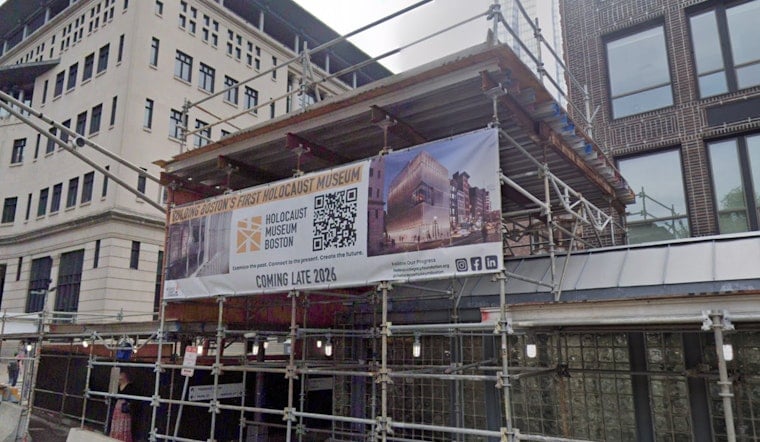
Construction crews are at work on a new Holocaust museum at the northeast edge of Boston Common, turning the corner of Tremont and Park streets into what organizers say will be New England’s first museum devoted entirely to Holocaust education. The vertical, six-story building is planned to house galleries, classrooms, and an exhibit bay that will hold a historic railcar, an artifact organizers say will be visible from the sidewalk. Museum co-founder Jody Kipnis has called the location intentional, a place to “weave together the histories of different communities” amid Boston’s core civic landmarks. Organizers told local media the museum is expected to open in spring 2027.
As reported by WHDH on June 4, Holocaust Survivor Day, the project was spotlighted as both a tribute to survivors and a public statement about the museum’s mission. WHDH noted Kipnis’s emphasis on placing the museum near the Common and the State House to connect the memory of the Holocaust with everyday public life.
The project is being developed by the Holocaust Legacy Foundation, whose newsroom has shared construction updates and continues to list a late 2026 opening on its site. Materials from the Holocaust Legacy Foundation and earlier coverage detail how the foundation acquired the site and expanded its vision into a roughly 33,000-square-foot museum at 125 Tremont Street. The Boston Globe reported that the foundation purchased the building for $11.5 million and outlined the project’s scope and fundraising goals.
One of the project’s most dramatic moments so far came in November, when a 12-ton, 30-foot railcar believed to be the same type used to deport people during the Holocaust was hoisted by crane into a fourth-floor exhibit bay. Organizers say this railcar will serve as the emotional centerpiece of the museum. In its coverage of the installation, JTA reported that the museum plans to let passersby see visitors enter the railcar but not exit, a symbolic design intended to confront viewers with the gravity of what the artifact represents.
What Visitors Will See
Inside, the permanent galleries are set to blend historical content with immersive technology, including holographic interviews with Holocaust survivors and dedicated learning spaces for students and teachers. Northeastern reported that the museum plans to organize its storytelling around themes such as propaganda, prejudice, and the breakdown of democratic norms, so that the lessons feel current rather than distant. Organizers say the collection will feature personal objects and rotating exhibitions that connect Boston audiences directly to survivor testimony.
Why the Location Matters
The museum’s placement along the Freedom Trail, across from Park Street Church and within sight of the State House, is no accident. Founders and civic leaders have described the site as a way to anchor Holocaust memory squarely in Boston’s public square. At the groundbreaking, officials and The Boston Globe framed the location as a constant reminder for residents, tourists, and the steady flow of student groups that pour through downtown.
Timeline, Funding and What’s Next
Organizers have floated slightly different opening dates. The Holocaust Legacy Foundation newsroom points to a late 2026 debut, while WHDH has reported a target of spring 2027. Construction costs are projected to exceed roughly $100 million as fundraising continues, according to The Boston Globe. The founders say they intend the museum to become a major resource for schools in a state that has mandated genocide education for middle and high school students. The Massachusetts Department of Elementary and Secondary Education notes that “An Act Concerning Genocide Education (Acts of 2021, c. 98)” requires instruction on the Holocaust and other genocides.
For people cutting across the Common at lunch and for the school groups that fill downtown sidewalks, the new museum is being built as a permanent, and at times uncomfortable, reminder of the cost of ignoring hatred and the civic work needed to stop history from repeating. Organizers say they hope its proximity to the Common and the State House keeps that work in plain view every day.





