

























































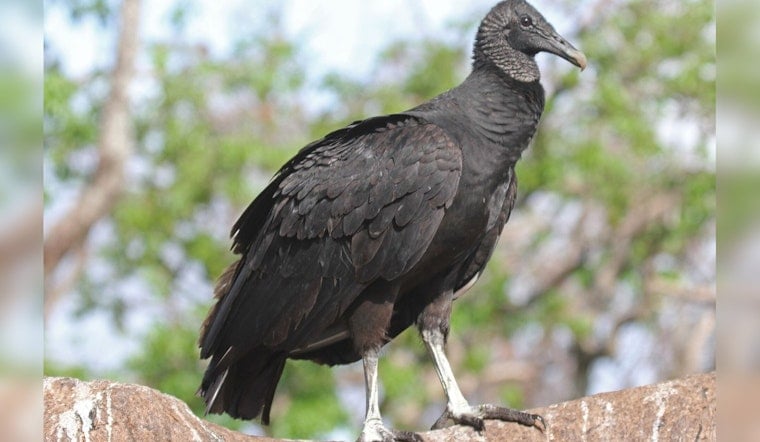
On a 70-acre spread near Thompsonville in northeastern Williamson County, calving season has turned into a high-stress stakeout for cattle farmer Patty Zettle. She says a growing flock of black vultures regularly circles her place, blames them for killing one of her calves last year, and now faces a tense and costly routine trying to keep the birds away. After losing the calf, which she estimates cost her upward of $2,000, Zettle has tried every deterrent she can think of and has applied for federal permission to remove a small number of the federally protected birds. The conflict has local producers, wildlife managers and federal regulators scrambling to balance livestock protection with wildlife law.
As reported by the Chicago Tribune, Zettle keeps at least 19 cows, 14 chickens and 16 goats on her farm. After last year’s calf loss, she turned to the federal depredation permit process, which would allow her to take a limited number of black vultures each year. The Tribune also noted that in May, she and her fiancé even resorted to hanging a dead vulture in a tree in an effort to scare the rest of the flock away.
Birds on the move
Black vultures have been shifting their range northward for decades, bringing them into far more frequent contact with Midwestern ranchers and farmers, according to Audubon. Researchers cited by Audubon point to warmer winters, habitat changes and a recovering vulture population as drivers of the expansion and note that tensions tend to spike in places where the birds are newly established and farmers are still figuring out how to respond.
How permits work in Illinois
To speed up relief for worried producers, Illinois Farm Bureau has obtained a statewide depredation permit and can now issue sub-permits directly to affected farmers, Farm Progress reported. A February 2026 memorandum from the U.S. Fish and Wildlife Service formalized a nationwide framework that allows one public entity in each state to hold a broad permit, then subpermit individual producers after consultation and documentation.
What farmers try and what science says
On the ground, producers lean on a grab bag of tactics: loud noises and pyrotechnics, guard animals, upside-down effigies and, where they have legal clearance, very limited lethal control to disrupt a vulture flock’s routine, according to Audubon. At the same time, a peer-reviewed study led by Purdue University researchers, published in PLOS ONE, cautions that vultures often scavenge so quickly after a death that they are frequently blamed for killings they did not commit. The paper lays out taphonomic signs investigators can use to tell the difference between genuine predation and postmortem scavenging.
Legal context
Black vultures fall under the Migratory Bird Treaty Act, which normally makes it illegal to kill them. However, Congress created a livestock-protection program that allows a single public entity in each state to hold a statewide depredation permit, as explained by Cornell LII in its discussion of 7 U.S.C. § 8356. The Fish and Wildlife Service’s February 2026 memorandum spells out how those statewide permits and any resulting subpermits must be issued and reported.
For Zettle, the bureaucracy and biology all condense into a daily standoff in her pastures. She told the Tribune she keeps a Benelli 12-gauge shotgun loaded with No. 3 steel shot close at hand and has fired at vultures that gather near newborn calves. The Chicago Tribune also reported that dozens of black vultures settle in at dusk on a cellphone tower and radio antenna near Crab Orchard, and that a Corinth Water District employee estimated roughly 50 birds sometimes perch on the district’s water tower. For farmers watching from below, those evening roosts are a stark reminder of why some are pushing for permits to remove a few birds when every other tactic has fallen short.





