

























































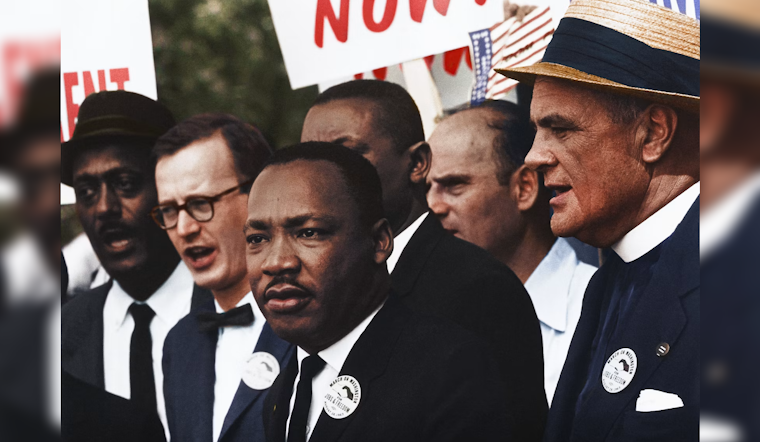
Sixty years after Martin Luther King Jr. was met with rocks, racial hatred and a brutal reception in Chicago’s Marquette Park, the city is preparing to walk that route again. This time, the procession will bring together surviving marchers, civic leaders, artists and thousands of supporters for a very different kind of confrontation with the past.
Chicago officials and civil rights leaders will retrace King’s 1966 march on Saturday, with original participants, Bernice King and Mayor Brandon Johnson expected to join the procession. The program will also feature a performance by Common, according to Axios Chicago.
The gathering is being billed as “The Fierce Urgency of Now,” a national, multi-faith march connecting Chicago’s civil rights history to current fights over voting rights, immigration detention, criminalization and economic inequality. Organizers say the march will begin with a pre-march program at 9 a.m., move out from 63rd Street and Kedzie Avenue at 11 a.m., and continue with speakers, music and community activities through the afternoon, according to the official event schedule.
A march that exposed Northern segregation
King’s Chicago campaign was aimed at housing discrimination, not just the better-known injustices of the Jim Crow South. The Chicago Park District notes that the 1966 Chicago Freedom Movement brought protesters into then-white residential areas near Marquette Park, where counterdemonstrators threw bottles, rocks and bricks at the marchers.
On Aug. 5, 1966, a rock struck King in the head and knocked him to the ground before he continued marching. He later said, “I have seen many demonstrations in the South, but I have never seen anything so hostile and so hateful as what I’ve seen here today,” a moment Axios reported as part of the history behind Saturday’s event.
The stakes were enormous for a city reshaped by the Great Migration. More than half a million Black people moved to Chicago from the South between 1917 and 1970, while discriminatory real estate and lending practices helped keep many families from buying homes in neighborhoods with greater resources.
The 1966 agreement promised fair housing
After the marches, Mayor Richard J. Daley met with King and other leaders to produce the Summit Agreement in late August 1966. The archived Summit Agreement included a commitment from Chicago mortgage bankers to make loans available to qualified families regardless of race.
That agreement became an important public acknowledgment of housing discrimination, but it did not magically erase redlining or residential segregation. The organizers of Saturday’s march are leaning into that unfinished business, framing the event not as a museum-piece reenactment but as a demand to connect the victories and failures of 1966 to today’s battles.
The setting itself carries some of that memory. Marquette Park is now home to the Martin Luther King Jr. Living Memorial, dedicated in 2016 with carved brick panels depicting King and the marchers, and Saturday’s procession will return the story to the streets where Chicago’s housing crisis became impossible for the nation to ignore.



