

























































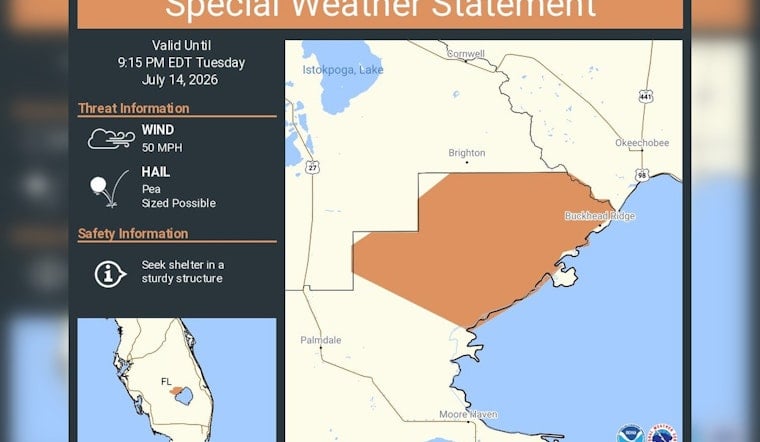
Glades County residents along the Lake Okeechobee corridor got a quick reminder Tuesday night that summer storms do not mess around. The National Weather Service in Miami issued a special weather statement warning that fast-moving thunderstorm cores could spin up pea-sized hail and wind gusts near 50 mph as a line of storms pushed through lakeside communities from Moore Haven to Brighton and other nearby towns.
The advisory, shared on NWS Miami’s social feed Tuesday evening, was valid through 9:15 p.m. EDT and specifically listed Lake Cornwell, Istokpoga, Moore Haven, Okeechobee and Brighton among the locations at risk. The post urged residents to “seek shelter in a sturdy structure” until the storms passed, according to NWS Miami.
Quick-hitting cores are routine over the lake
Short, intense storm cells are a regular feature along the Lake Okeechobee corridor in the warm season and can ramp up quickly into gusty, hail-producing cores. A June outbreak of hail and 50 mph gusts in nearby towns highlighted how these bursts can blow in fast, do their damage and be gone almost as quickly.
What the official products say
National Weather Service special weather statements for South Florida flag the main concerns as pea-sized hail and radar-indicated wind gusts up to about 50 mph, along with frequent cloud-to-ground lightning and pockets of heavy rain. The text notes that those winds can knock down small tree limbs and send unsecured objects flying, and it advises people to head into a safe building or vehicle until the storm moves on, as detailed by the National Weather Service.
Summer timing and water safety
These quick-forming squalls are a hallmark of South Florida’s wet season, which typically runs from mid-May through October and delivers most of the region’s afternoon and evening thunderstorms. Per the South Florida Water Management District and NWS climate guidance, lake communities and boaters on Lake Okeechobee should stay especially alert and seek shelter as soon as thunder is heard.
Residents are urged to keep NOAA Weather Radio, local broadcast alerts and the NWS Miami feed close at hand for updates and to follow any additional instructions from emergency managers if conditions deteriorate. See the original advisory on NWS Miami and refer to the agency's product page for the latest statements.



