

























































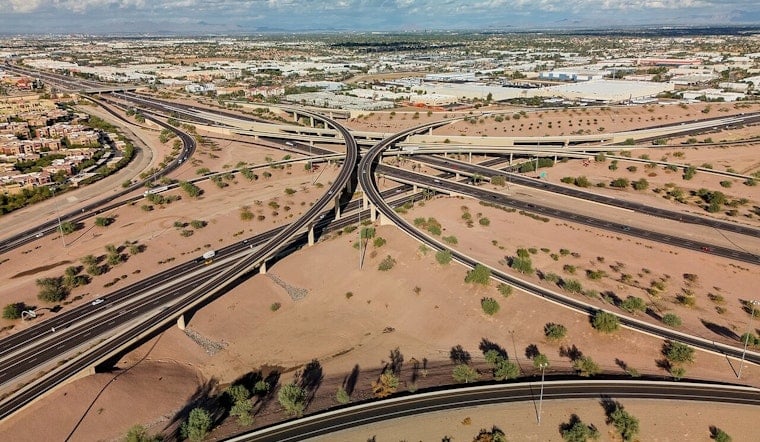
For almost 25 years, Interstate 10 has seen the same nightmare play out again and again in greater Phoenix and across Arizona: deadly wrecks piling up in familiar spots, with eerily similar mechanics. Drivers, first responders and grieving families talk about the same grim list, over and over again, of head-on collisions, chain-reaction crashes in blowing dust and wrong-way impacts that erase entire lives in seconds. A new statewide review pulls those stories and statistics together, forcing a hard question: are engineering and enforcement really keeping up with what this highway demands?
A fresh 25-year review by The Arizona Republic tracked crashes from the state’s western border, through metro Phoenix and into southern Arizona. The analysis highlights repeat hotspots and familiar failure points that show up year after year. By pairing crash records with firsthand accounts, the reporting shows how the same pieces of roadway can generate tragedies across decades. Over and over, the same culprits surface: wide, unprotected medians, sudden weather shifts, impaired driving and high speeds scattered all along the I-10 corridor.
Statewide toll and trends
Arizona recorded 1,228 motor-vehicle fatalities in calendar year 2024, which works out to roughly 3.36 deaths every single day, according to the Arizona Department of Transportation’s 2024 Crash Facts. That report names alcohol, speed and high-speed rural corridors as key contributors and puts the fatality rate at about 1.74 deaths per 100 million vehicle miles traveled. National comparisons from the Insurance Institute for Highway Safety show Arizona’s fatality rate still running higher than in many other states.
A family and a lawsuit that followed
One of the cases that defines this pattern happened in August 2007 near milepost 171, when a minivan carrying Michael Glazer and his 6-year-old daughter Sydney was hit after another vehicle crossed a wide dirt median. Michael and Sydney were killed, and Diana Glazer was badly hurt. The family later sued the state, arguing that a median barrier should have been in place. Court records in Glazer v. State detail how the crash unfolded and the jury award that followed. Diana Glazer’s memory of the aftermath, including her desperate questions about her husband and daughter, is preserved in reporting by The Arizona Republic.
Why crashes keep happening
Safety experts tend to circle back to a familiar set of problems: long stretches of unprotected median that allow vehicles to cross into oncoming lanes, drivers who are impaired or simply exhausted, and the kind of abrupt visibility loss that comes with dust storms during monsoon season. Wrong-way crashes on high-speed freeways are especially brutal. An investigation of state data and reporting by AZ Law Now finds that about two-thirds of wrong-way collisions involve impairment, and those incidents often become head-on hits at full highway speed. The same patterns show up in federal FARS summaries and in local corridor studies, which safety advocates say are a flashing red light for targeted engineering fixes, not just more tickets and patrol cars.
What officials are doing
State and regional transportation officials point to major construction projects and new technology as their most direct tools. The Maricopa Association of Governments calls out the 11-mile I-10 Broadway Curve Improvement Project as a full-scale rebuild for one of the region’s most heavily used stretches, while ADOT has deployed thermal-camera wrong-way detection and a dust-detection warning system along certain vulnerable segments. See the MAG summary of Proposition 400 projects and ADOT’s safety pages for details on those efforts. ADOT officials say these systems help law enforcement spot and respond to danger faster, but ongoing reporting and crash totals suggest that detection by itself cannot stop the worst tragedies without physical roadway changes and consistent funding.
Legal fallout and accountability
When families believe design choices helped cause a crash, they sometimes take their arguments into court. Juries and appellate judges have weighed whether the state met its duty to provide reasonably safe highways, with expert witnesses walking through barrier design, crash history and what engineers knew at the time. The Glazer case, and the appeals that followed it, show how families try to hold the state accountable when they say the road itself failed them. Lawyers and safety advocates note that big civil judgments can spur long-delayed projects into motion, although the actual construction still depends on budgets and political decisions.
Together, the data and reporting point to a blunt conclusion: the same hotspots and the same causes keep showing up, which means many I-10 deaths are preventable if fixes move to the front of the line. Families, first responders and transportation planners are watching to see whether new projects, detection systems and carefully placed barriers finally break that deadly pattern before another life is lost.





