

























































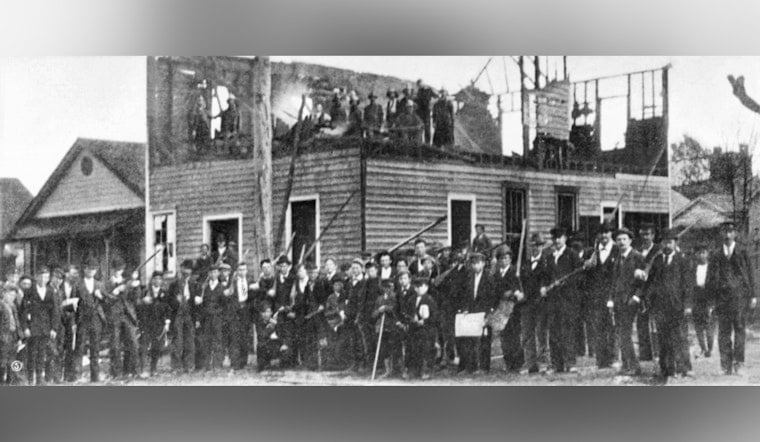
On a quiet block in downtown Wilmington, a low metal memorial and a hard-to-spot plaque carry the weight of a violent coup. The marker recalls Nov. 10, 1898, when an organized white mob torched the city’s only Black newspaper, shot Black residents in the streets and drove out a legally elected, biracial city government at gunpoint. That single day shattered lives, emptied neighborhoods and wiped out political power that Black North Carolinians had spent decades building.
Dragging that history back into the national spotlight is a recent feature from CBS News, built around an excerpt from Lauren Collins’s forthcoming book and fresh reporting with descendants and historians. The piece details how a mob burned The Daily Record, opened fire at Fourth and Harnett Streets and, according to witnesses, rolled a cart fitted with a rapid-fire gun through largely unarmed Black neighborhoods. Minutes from conspirators’ meetings singled out a Black laborer, Joshua Halsey, who relatives say was later killed. As CBS News reports, those scenes became the starting point for a long and deliberate local silence.
How the violence unfolded
Eyewitness accounts and later investigations make clear that what happened in Wilmington was not a chaotic street fight, it was a planned assault carried out by heavily armed men. Reporters at the time described volleys from repeating rifles and militia units that hauled a Colt rapid-fire gun into Black neighborhoods. Estimates of the death toll vary, since contemporary accounts conflict and later historians have cited figures ranging from dozens to several hundred. A state commission eventually concluded that armed white vigilantes massacred as many as 60 Black residents.
Photographs of the burned Daily Record office and groups of armed men posing proudly in front of the ruins turned into grisly trophies for the attackers. The violence drove thousands of Black residents from their homes. As Smithsonian Magazine has noted, the scale, preparation and precision of the attack mark it as a coordinated coup, not a spontaneous riot.
The political takeover
The mob’s endgame was straightforward, seize political power. White Democrats marched on City Hall, where a board that included Black aldermen was in session. Under the immediate threat of violence, those duly elected officials resigned. Insurgent leaders then installed their own slate of officeholders and declared that they had “reclaimed” Wilmington for white rule.
The state commission that later investigated the events of 1898 laid out how partisan newspapers, coordinated political organizing and paramilitary groups worked together to manufacture consent for the coup and then carry it out at City Hall. The commission’s record also notes a stark fact, no one was ever prosecuted for the killings, expulsions or the overthrow itself. The full findings and context are collected in the official report, the 1898 Wilmington Race Riot Report.
Ripple effects that lasted generations
In the immediate aftermath, Wilmington’s Black neighborhoods lost their leaders, much of their property and significant capital. Before the coup, Black residents made up a majority of the city’s population; the violence and forced removals helped clear the way for long-running efforts to strip Black North Carolinians of the vote and economic opportunity. Jim Crow laws and systematic exclusion followed.
CBS News notes that Wilmington was about 56 percent Black at the time of the coup and is roughly 15 percent Black today, a demographic shift that traces in part to the terror and displacement of that November. Those long shadows are why descendants and local activists continue to push for education, public memorials and economic repair. Community leaders told CBS News that honest history in classrooms and public spaces is central to any real reckoning.
Why now: a book and renewed attention
Interest in Wilmington’s 1898 coup has surged as new scholarship and film projects bring the story to wider audiences. Lauren Collins’s book They Stole a City, scheduled for release on July 14, 2026, and a recent installment of the documentary series American Experience have helped push the episode back into national conversation.
The publisher’s listing for Collins’s book and the companion materials from American Experience gather interviews, archival photographs and testimony that put descendants’ voices at the center of the narrative. For more on how researchers and families are telling this story today, see Penguin Random House and PBS’s American Experience.
Legal aftermath
For decades, the legal system simply moved on. Federal and state officials declined to prosecute the leaders of the coup, and the new political order those men imposed went largely unchallenged. It was not until the 2000s that a state commission undertook a full public investigation of the planning, the massacre and the economic devastation that followed.
The commission recommended a series of steps, including proposals aimed at reparative measures, that legislators ultimately did not enact. Even so, its report remains the most detailed public accounting of what the organizers themselves called a “White Declaration of Independence.” For anyone looking to understand both the events of 1898 and their long tail, the 1898 Wilmington Race Riot Report lays out the evidence, findings and policy suggestions in full.





