

























































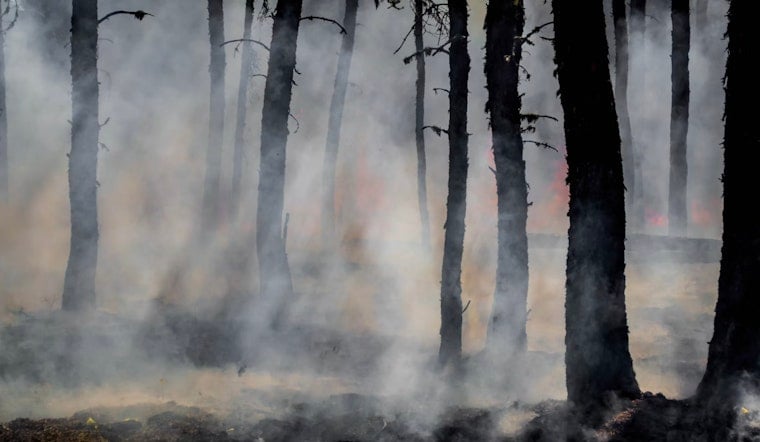
A 200-acre brush fire is burning out of control in western Miami-Dade County, sitting at 0% containment as of Thursday and sending enough smoke into the air to trigger a countywide air quality alert. The fire is burning near mile markers 41 to 43 along a remote stretch of the Everglades, and crews are working to knock it down as a heat advisory bakes the region with dangerously high temperatures.
The Florida Forest Service is leading efforts to contain the blaze, according to WSVN, which reported that lingering smoke trapped close to the ground prompted the National Weather Service Miami office to issue the air quality alert for Miami-Dade County. The stretch of U.S. Route 41, better known as Tamiami Trail, sits near the entrance to Big Cypress National Preserve and Kirby Storter Roadside Park, a remote pocket of Everglades wetland where emergency access and water sources are severely limited, according to local geographic data.
Adding to the danger, a heat advisory remains in effect across South Florida, with heat index readings projected between 105 and 112 degrees Fahrenheit, per the station's report. Under National Weather Service Miami policy, that kind of advisory is issued only when heat index values are forecast to hit or exceed 105 degrees for two or more consecutive hours, a threshold that also raises heat exhaustion risks for ground crews working near active flames.
A Summer of Relentless Everglades Fires
This is far from an isolated incident. Less than three weeks earlier, the 750-acre Blue Gill Wildfire ignited near Southwest 8th Street and Krome Avenue, an inferno Hoodline reported was still 0% contained in early August. Just days ago, three additional Everglades brush fires forced a temporary shutdown of Krome Avenue, trapping drivers for hours.
Zoom out further and the pattern gets starker. In June, western Miami-Dade endured a severe wildfire wave led by the Quarry 2 Fire, which scorched 19,018 acres near Doral, and the Well Fire, which burned 2,814 acres, pushing the county's total seasonal burned acreage past 20,000 acres, according to CBS Miami. Statewide, the Florida Forest Service responded to more than 1,500 wildfires that burned over 54,000 acres between January and April, already exceeding half the total number of fires recorded in all of 2025, per Central Florida Public Media.
Drought Conditions Are Feeding the Flames
The underlying culprit is drought. In July, the National Weather Service placed far western Miami-Dade County under D3 Extreme Drought conditions, with soil moisture deficits driving high wildfire potential across the interior Everglades. Keetch-Byram Drought Index readings in the area reached 400 to 500, a level indicating dry duff layers that actively feed ground fires, according to the agency's regional drought statement.
To fight fires in this kind of marshy, hard-to-reach terrain, Florida Forest Service crews rely on specialized tractor-plow units that dig firelines down to bare mineral soil, along with heavy brush trucks and aviation support from fixed-wing spotter planes and water-dropping helicopters, according to UF/IFAS Extension. Those scraped firelines create bare-earth breaks meant to starve advancing flames of the combustible plant matter that lets a ground fire spread.
Why the Smoke and Heat Are Both Dangerous
The air quality alert stems from a specific atmospheric trap: light winds and low-level temperature inversions can pin fine particulate matter, known as PM2.5, close to the surface instead of letting it disperse into the upper atmosphere. Those fine particulates can penetrate deep into the lungs, triggering respiratory and cardiovascular strain, a mechanism CBS Miami has detailed in prior coverage of South Florida wildfire smoke.
There's also a road-safety dimension that has played out before along this same corridor. Florida Highway Patrol and local emergency responders have warned that when wildfire smoke mixes with nighttime and early-morning moisture over Everglades highways like Tamiami Trail, it can create dense super fog capable of reducing driver visibility to zero, prompting road closures when conditions turn hazardous.
Florida law gives county governments the authority to enact local outdoor burn bans during periods of high fire risk, while the Florida Forest Service can restrict open burning authorizations when regional Fire Readiness Levels climb to elevated thresholds, per UF/IFAS Extension. It remains to be seen whether shifting winds will push this fire's smoke deeper into populated Miami suburbs or whether Florida Highway Patrol will need to close sections of Tamiami Trail as containment efforts continue.



