

























































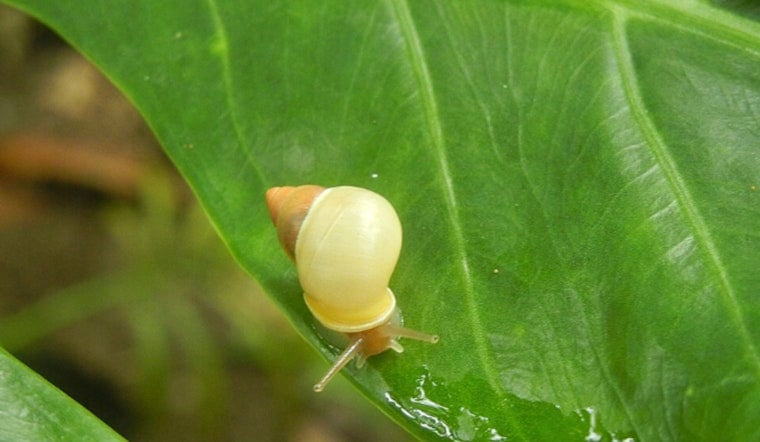
Thirty-four endangered humped tree snails, each barely bigger than a fingernail, arrived at the Saint Louis Zoo in August after scientists raced to pull them off Guam ahead of Category 5 Super Typhoon Bavi. The snails are now settling into the zoo's Insectarium, and the arrival marks the first time the species has ever been brought under professional care at an Association of Zoos and Aquariums-accredited institution.
University of Guam scientists collected the quarter-size *Partula gibba* snails using empty peanut butter jars before the storm hit in July 2026, according to St. Louis Public Radio. Kayla Garcia of the U.S. Fish and Wildlife Service traveled to Hawaii to pick up the snails and was later escorted through the airport by the federal agency on the way to St. Louis, per the same report. The rescue effort unfolded ahead of the Category 5 storm making landfall on Guam, and the snails were temporarily sheltered by Hawaii's Snail Extinction Prevention Program before continuing their journey.
A Single Storm Could Have Wiped Out the Species
Garcia said the surveyed Guam population had continued to decline even before Bavi threatened to wipe it out entirely, the station's report notes. That vulnerability traces back to where the snails were found: the sole remaining wild population on Guam was restricted to a single localized area on the Naval Telecommunications Station, according to the Pacific Island Times. University of Guam scientists had to work with the U.S. Marine Corps to access the military base where one of the last known populations lives, per the same STLPR account.
*Partula gibba* was once abundant across Guam and nine Northern Mariana Islands, but the population declined from thousands of snails to just dozens across a few known populations, Garcia said, according to the station's reporting. Adding to the pressure, tropical forests across the Mariana Islands were still recovering from Typhoon Sinlaku in April 2026, which weakened canopy shelter just three months before Bavi arrived, according to the Saint Louis Zoo. Stronger and more frequent typhoons have ripped away the tree canopy that creates the snails' preferred climate, and the species has also suffered broader habitat loss over time.
Tiny Decomposers With an Outsized Forest Role
Adult humped tree snails measure just 14 to 18 millimeters long and live up to five years, but they play a vital role as forest decomposers, according to the U.S. Fish and Wildlife Service. The snails eat a leaf film that can contain fungus and other bacteria, helping keep forests healthy and preventing plant disease. Introduced flatworms have preyed heavily on the snails, part of a broader pattern in which invasive predators like the rosy wolfsnail and the New Guinea flatworm have driven native Pacific island land snail species to extinction rates between 30 and 80 percent, according to a February 2026 review in Philosophical Transactions of the Royal Society B.
The species has carried cultural weight on Guam as well: people have made jewelry out of *Partula gibba* shells, per the STLPR report. The federal government listed the humped tree snail as endangered in 2015, and it now numbers over 50 including babies at the St. Louis Zoo, Garcia said, since some of the rescued snails have already produced offspring in their new home.
Decades of Experience With Rare Pacific Snails
The Saint Louis Zoo is now the only zoo in the world to house *Partula gibba*, but the institution has worked with other *Partula* snail species for decades. The zoo's WildCare Institute has supported international *Partula* snail conservation continuously since 1990, funding field research, equipment, predator-exclusion reserves, and reintroductions in French Polynesia, according to the Saint Louis Zoo. That long-running work paid off in March 2025, when the IUCN Red List reclassified a related species, *Partula tohiveana*, from Extinct in the Wild to Critically Endangered following decades of zoo-led captive breeding that established wild-born populations in French Polynesia, per the Royal Zoological Society of Scotland.
St. Louis Zoo plans to eventually reintroduce the humped tree snails to Guam, per Garcia's comments to STLPR, though the timeline for that reintroduction remains unclear. The taxonomic picture has also grown more complicated: a May 2026 genetic and morphological study found that tree snails on Rota Island long classified as *Partula gibba* are actually a distinct new species, *Partula lutaensis*, narrowing the known range of the true species and adding new urgency to conservation planning, according to research posted on ResearchGate.
For now, the rescued snails are simply settling in at the zoo's Insectarium, adjusting to life thousands of miles from the Pacific forests their ancestors called home. Their arrival builds on a broader interim rescue network: the Hawaii Snail Extinction Prevention Program, which sheltered the Guam snails before their trip to St. Louis, has separately worked to give Hawaii's own native snails predator-proof shelter as well.



.jpg)