

























































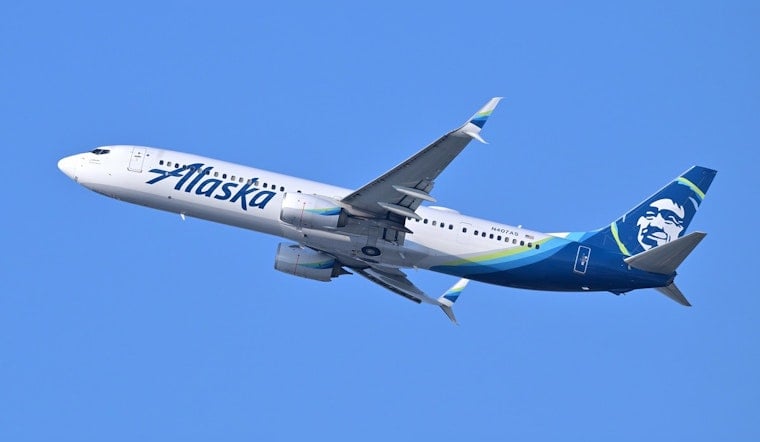
Alaska Airlines Flight 305 was taxiing for departure at Miami International Airport on Sunday when its pilot radioed for law enforcement help after flight attendants reported that passengers on board had threatened to take over the aircraft. The Seattle-bound Boeing 737-900ER never left the ground. Pilots shut down the engines, set the parking brake, and sealed the cockpit before deputies met the plane and pulled everyone off for a security sweep.
According to the New York Post, air traffic control audio captured the pilot reporting that flight attendants had received threats from customers on board, including one warning that a passenger intended to take over the aircraft. The jet, registration tail number N592AS, was scheduled to fly nonstop from Miami to Seattle-Tacoma International Airport, according to FL360aero. A statement from the Miami-Dade Sheriff's Office indicated that Airport District deputies responded to gate E6 around 6:40 p.m. local time after a flight attendant reported suspicious activity, per Paddle Your Own Kanoo.
Deputies Deplane Everyone Out of Caution
Miami-Dade deputies deplaned all passengers out of an abundance of caution, the same report notes, so the aircraft could be thoroughly swept. After the search, police determined there was no credible threat aboard the jet. Two individuals connected to the alleged threats were rebooked on another flight, police reported, rather than being taken into custody on the spot.
Alaska Airlines confirmed that the two disruptive passengers were removed by law enforcement at the gate and issued a temporary ban from flying with the airline, per the same account. The carrier said it was working to reaccommodate guests affected by the disruption. FlightAware data showed the flight was expected to finally depart Miami around 6:43 p.m. local time Monday, well after its original schedule.
Why a Lockdown But No Hijacking Charges
The pilots' response followed cockpit lockdown protocols standardized across U.S. commercial aviation after the September 11, 2001, terrorist attacks, which require pilots to electronically seal reinforced flight deck doors and deny entry during suspected airborne security threats, according to Simple Flying. That standard demands an immediate, zero-risk defensive posture from crews the moment a threat is relayed, regardless of whether it later proves credible.
But criminal exposure works differently. Federal statutory standards under 49 U.S.C. § 46502 define aircraft piracy as the actual seizure or exercise of control over an aircraft through force, violence, or intimidation, meaning verbal statements alone, without a physical attempt to take control, do not meet the legal threshold for air piracy, per destination.com. That gap between the crew's emergency response and law enforcement's ultimate findings explains why the pair walked away with a rebooking and an airline ban rather than immediate federal charges.
That does not mean interfering with a flight crew carries no legal risk. Under 49 U.S.C. § 46504, assaulting, intimidating, or interfering with a flight crew member or flight attendant in the performance of their duties is a federal felony punishable by up to 20 years in prison and severe fines, according to Criminal Defense Lawyer. Separately, the FAA can assess civil penalties of up to $43,658 per violation against unruly passengers, penalties that can stack for multiple infractions on a single flight on top of any criminal prosecution, per the FAA's own guidelines.
Part of a Rocky Year at MIA
The incident adds to a string of passenger disruptions at Miami International Airport in 2026, including an April aisle brawl on an incoming American Airlines flight and a March pre-departure arrest on a Southwest flight, both previously reported by Hoodline. Nationally, FAA data reported by Paddle Your Own Kanoo shows federal regulators logged more than 1,000 unruly passenger reports in 2026 through early August, a rate still well above pre-2021 baselines even though it has fallen sharply from nearly 6,000 reports at the 2021 peak.
One footnote made the rounds among aviation watchers Sunday: Flight 305 shares its designation with Northwest Orient Airlines Flight 305, the Boeing 727 hijacked by D.B. Cooper in November 1971 in one of commercial aviation's most famous unsolved cases. Aviation analysts told destination.com the numerical match was purely coincidental and unrelated to Sunday's events in Miami.





