

























































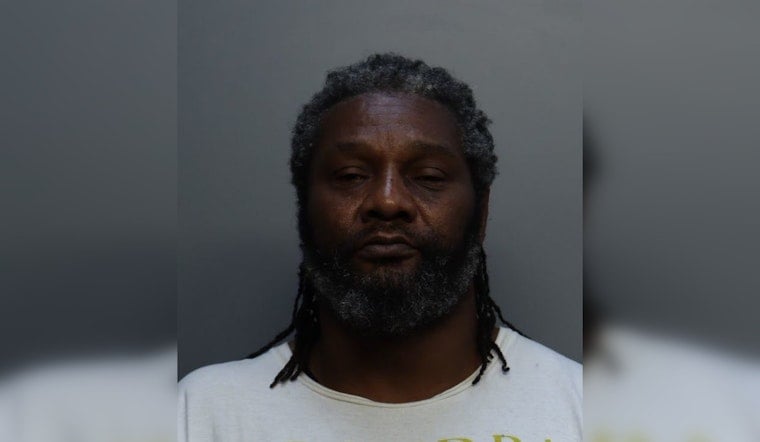
A Miami man is facing two felony charges after police say surveillance video captured him punching his disabled girlfriend in the face while she sat on her assistive walker in Allapattah. Charles Anderson was arrested Tuesday and now faces charges of aggravated battery with great bodily harm and aggravated abuse of a disabled adult, according to police.
The case began on July 24, when Miami police officers responded to an apartment near Northwest 18th Avenue and 27th Street after a neighbor reported hearing the victim yelling, as reported by WPLG Local 10. The woman, who has a disability and is unable to walk, told officers that her boyfriend of six years had beaten her. Surveillance video reviewed by police reportedly showed Anderson approaching her while she was seated on her walker and punching her in the face with closed fists in an aggressive manner without apparent provocation, according to the police arrest report.
According to the victim, the confrontation started after Anderson asked her for money to buy gas and she refused. The arrest report states that Anderson fled the scene after noticing she was bleeding. Miami Fire Rescue personnel later transported her to Jackson Memorial Hospital, where she was treated for a laceration beneath her chin that required stitches, per the police report.
Suspect Detained Weeks Later, Then Confessed
Anderson was not taken into custody the day of the alleged attack. Miami police officers detained him for questioning on Tuesday at 2:30 pm near Northwest First Avenue and 20th Street, according to the same report. Once in custody, Anderson confessed to assaulting the victim, police said.
In his own account to police, Anderson said he and the victim got into a verbal altercation that caused him to become upset, and he told investigators he blacked out and put his hands on her, according to the arrest report. Miami-Dade Corrections booked him at the Turner Guilford Knight Correctional Center shortly before 6:55 pm Tuesday, and he was given a $22,500 bond.
Why He Stayed Behind Bars Before Bond Was Set
Anderson could not simply pay his way out the moment he was booked. Under Florida court procedures and local jail guidelines, people arrested on domestic violence charges are barred from posting bond immediately and must remain detained until a mandatory first appearance hearing before a judge, according to the Miami-Dade Public Defender's Office. That process explains the gap between his booking and the setting of bond in his case.
The charges against Anderson carry substantial prison exposure. Under Florida Statute § 825.102(2), aggravated abuse of a disabled adult is a first-degree felony punishable by up to 30 years in state prison, an offense level the Legislature elevated from a second-degree felony in 2008, according to the Brancato Law Firm. Separately, Florida Statute § 784.045 classifies aggravated battery causing great bodily harm as a second-degree felony carrying up to 15 years in prison and a $10,000 fine, per Terrezza Law. Because the couple lived together for six years, the case also falls under Florida's domestic violence statute, § 741.28, which defines such violence to include battery between cohabitants and former household members.
A Neighborhood Wary of Reporting Abuse
Allapattah is a historic, working-class neighborhood in west-central Miami, named for the Seminole word for alligator, and known as a cultural melting pot with large Dominican, Cuban, and Central American populations, according to the IN Miami Group. It was a neighbor there who first alerted police after hearing the victim yelling, a detail that underscores how often abuse against disabled adults surfaces only through outside witnesses rather than victims themselves.
That pattern reflects a broader, documented problem. Research cited by the U.S. Department of Justice Office for Victims of Crime, and compiled by Disability Justice, indicates more than half of crime victims with disabilities never report violent incidents to police, often out of fear of reprisal, fear of losing housing or personal care support, or a belief that officers cannot help them. Nationally, the Bureau of Justice Statistics found in a November 2021 report that people with disabilities experience violent victimization at a rate of 46.2 per 1,000 people, nearly four times the rate of 12.3 per 1,000 among people without disabilities.
In Miami-Dade County specifically, domestic violence offenses climbed from 6,684 reported incidents in 2020 to 7,769 in 2021, according to data published on FLHealthCHARTS. Under Chapter 415 of the Florida Statutes, anyone, including law enforcement, with reasonable cause to suspect abuse of a vulnerable or disabled adult is legally required to report it to the Florida Abuse Hotline, which can trigger a state protective investigation through the Florida Department of Children and Families.
It remains unclear whether Anderson has posted his $22,500 bond, whether a judge will impose a no-contact order once he is released, or whether Florida's Adult Protective Services will open a separate administrative investigation into the victim's ongoing safety and care arrangements. Anderson was booked at the Turner Guilford Knight Correctional Center, Miami-Dade County's main facility for booking and pre-trial detention.




