

























































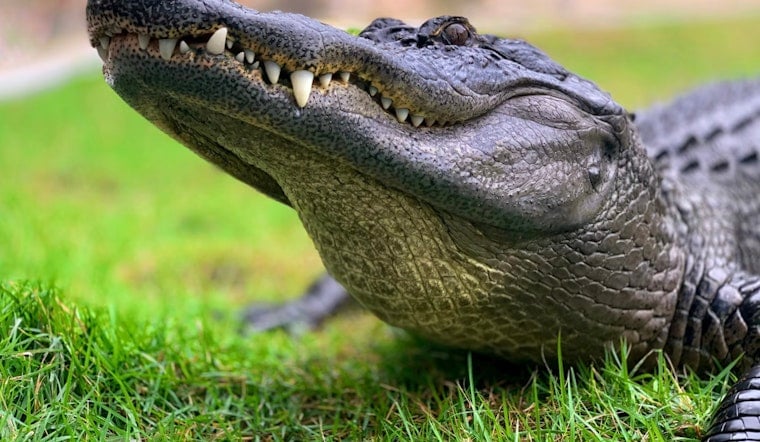
An alligator strolled down Northwest 67th Avenue in Miami Lakes on Wednesday, drawing a crowd of drivers who slowed down to snap photos as the reptile ambled along the pavement. At one point, a driver tried nudging the animal off the road using a tow truck, but the gator held its ground and remained on the street.
The sighting was captured on video and posted to social media, showing motorists passing the alligator while others stopped to take pictures, according to WSVN 7News. The outlet, which first reported the encounter Wednesday, said the alligator's ultimate outcome was unclear — it's not known whether the animal wandered off on its own, was captured by wildlife officials, or something else entirely.
Nudging a wild alligator with a vehicle, even one as large as a tow truck, is not without legal risk. Under Florida Statute § 379.409, intentionally capturing, harassing, or attempting to physically interfere with a wild alligator without a state permit is a third-degree felony, punishable by up to five years in prison and a $5,000 fine, according to Florida's statutes.
Why Miami Lakes Keeps Seeing Gators on Its Streets
Miami Lakes wasn't built by accident around water. The town was master-planned by the Graham family starting in 1962 on former dairy farmland and engineered around 23 artificial lakes connected by drainage canals that tie into South Florida's broader waterway network, according to The Miami Laker. Those interconnected canals function as ready-made travel corridors for wildlife moving between wetlands and neighborhoods.
Timing likely played a role too. The Florida Fish and Wildlife Conservation Commission's biological records note that alligator eggs hatch annually from mid-August through early September, a seasonal window when alligators show heightened movement across land and roadways. That hatching cycle lines up with Wednesday's sighting along Northwest 67th Avenue.
What Happens When Wildlife Officials Get Involved
Florida residents who spot a nuisance alligator are urged to call the state's toll-free hotline, 866-FWC-GATOR, rather than approach the animal themselves. The Florida Fish and Wildlife Conservation Commission's Statewide Nuisance Alligator Program dispatches contracted, licensed trappers whenever an alligator is at least four feet long and considered a threat to people, pets, or property.
But capture rarely means release back into the wild. Under FWC guidelines, nuisance alligators measuring four feet or longer are generally not relocated because they tend to try to return to their capture site or provoke territorial fights with other gators; trappers typically euthanize the animals instead and sell their hides and meat, per Orlando Weekly. It remains unknown whether trappers were called to the Miami Lakes scene or what became of this particular animal.
A Familiar Pattern Across Florida Neighborhoods
Miami Lakes is far from alone in dealing with roaming reptiles. The FWC receives roughly 14,000 to 15,000 nuisance alligator complaints statewide every year, with nearly 80 percent resulting in a trapping permit, according to News4JAX. Florida is home to an estimated 1.3 million wild alligators spread across all 67 counties, a population that decades of conservation work helped restore.
Despite the visibility of encounters like the one on Northwest 67th Avenue, actual attacks remain statistically rare. The state averages just eight to 10 unprovoked alligator bites a year that require medical treatment, putting an individual's risk of serious injury at roughly 1 in 3.1 million, per the Florida Fish and Wildlife Conservation Commission. From 1948 through 2025, the agency documented 500 total unprovoked bites statewide, 32 of them fatal, according to FOX 35 Orlando.
Wednesday's encounter follows a string of similar South Florida sightings this year, including a 10-foot gator near a Coconut Creek school earlier in August and a 9-foot alligator that turned up doing laps in a Venice family's backyard pool in July. Officials continue to warn residents never to feed wild alligators, a practice banned under state rules carrying fines up to $500 because it causes the animals to lose their natural fear of people.



