

























































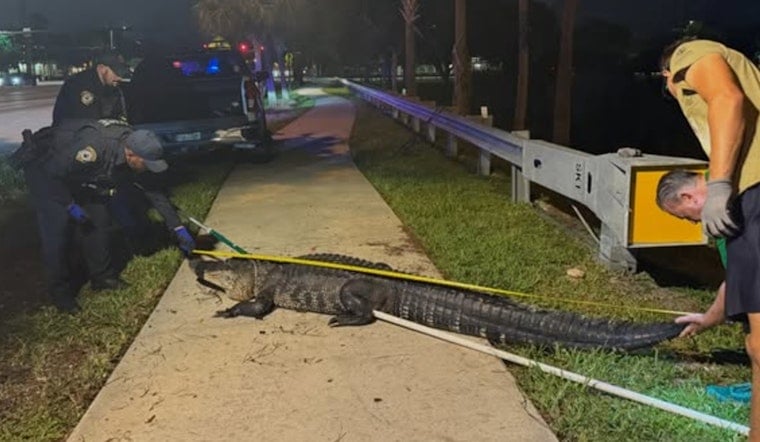
A 10-foot, 300-pound alligator turned up in a canal bordering Coconut Creek High School on Friday, just three days before Broward County students head back to class. The reptile was spotted at the canal near Creek Parkway and Lyons Road, right along the edge of the school campus.
According to the WPBF report, first detailed by assignment editor Allen Cone, the Coconut Creek Police Department posted about the sighting and could not resist having some fun with it, joking that the alligator might have been waiting around for the high school to open on Monday. Officers compared the canal to a Buc-ee's for alligators and suggested the massive reptile could have played left tackle on Creek High's football team.
Broward County Public Schools has set Monday, August 10, 2026, as the first day of the 2026–2027 school year, meaning the alligator picked its canal-side spot just days before hallways and athletic fields fill with students again. The district enters the new year on the heels of an “A” rating from the Florida Department of Education for a third consecutive year, according to Broward County Public Schools. Coconut Creek High is also among six Broward high schools receiving new artificial turf athletic fields this year, part of a push that brings the district's completed turf-field total to nine, per the same district materials.
How the Gator Ended Up in the Canal
Coconut Creek High School sits along Coconut Creek Parkway near Lyons Road, an area bounded by drainage canals that connect to a broader regional canal system. Those waterways link Everglades wetlands to residential retention ponds, giving large reptiles like this one a natural travel corridor between rural and suburban Broward County, per Broward County Public Schools facility records. Coconut Creek's canal and retention pond network runs along numerous schools and residential developments, a reality the Coconut Creek Police Department has addressed before — the department partnered with FWC officials in February 2024 for a public wildlife awareness seminar at the Rowe Activity Center focused on coexisting safely with suburban coyotes and alligators.
The Coconut Creek Police Department said friends and community partners from Florida wildlife officials helped locate the alligator and move it to Everglades Holiday Park, a 29-acre county-owned wetland park on Griffin Road in Fort Lauderdale. The park is a major public gateway for airboat tours, fishing trips, and alligator sanctuary rescues, and ranks among the most visited destinations in Broward County's park system, according to Broward County Parks and Recreation.
Why Relocation Was the Unusual Outcome
Under the Florida Fish and Wildlife Conservation Commission's Statewide Nuisance Alligator Program, a gator generally qualifies as a nuisance once it reaches four feet in length and is believed to pose a threat to people, pets, or property. The commission maintains a toll-free Nuisance Alligator Hotline, 866-FWC-GATOR, for exactly these kinds of reports.
Live relocation to a park is not the typical result for an alligator this size. FWC policy generally calls for captured nuisance alligators measuring four feet or longer to be euthanized or sold to alligator farms rather than released, since adult gators frequently try to find their way back to the site where they were caught. FWC fields roughly 14,000 nuisance complaints statewide each year, and nearly 80 percent result in a removal permit, per the commission's own data. That the Coconut Creek gator was moved intact to Everglades Holiday Park's wetlands, rather than euthanized, stands out against that backdrop.
A Familiar Sight Before the School Bell Rings
This was not an isolated back-to-school reptile encounter in Florida this summer. One week earlier, on July 31, Osceola County Sheriff's deputies captured a wild alligator in the baseball bullpen at Tohopekaliga High School in Kissimmee while student-athletes practiced nearby, according to a Facebook post from the Osceola County Sheriff's Office. Hoodline previously covered deputies' quick gator rescue in that incident, which ended without injury or disruption to school activities.
Florida is home to an estimated 1.3 million wild alligators spread across all 67 counties, occupying nearly every natural freshwater body capable of supporting them, according to the Florida Fish and Wildlife Conservation Commission. That population has stayed stable since controlled harvests resumed in 1988. Despite how often alligators turn up in canals, retention ponds, and even school bullpens, FWC historical records dating back to 1948 show the state averages about eight major unprovoked bites a year, with 32 confirmed fatal attacks over that 78-year span — odds wildlife officials put at roughly 1 in 3.1 million for a Florida resident being seriously injured in an unprovoked encounter.
Wildlife officials also point to human behavior as a major driver of these encounters. Under Florida Statute Section 372.667, intentionally feeding wild alligators is a criminal offense, because feeding causes the animals to lose their natural fear of people and start seeking out populated areas near food sources. Experts say human feeding is involved in the vast majority of nuisance alligator reports across the state.





