

























































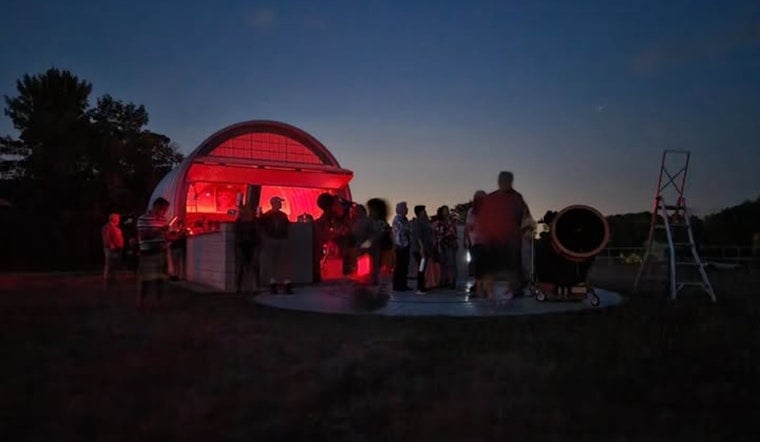
Stargazers heading to Baylor Regional Park next Friday through Sunday will find the campground already tightening up, with utility sites sold out for Camping with the Stars, the annual overnight astronomy weekend centered on Eagle Lake Observatory in western Carver County. Weekend admission runs $5 per person, with children 5 and under getting in free, and the fee covers a Sunday continental breakfast for anyone registered to camp.
According to Carver County Parks, primitive, ballfield and group campsites are still open even though the utility sites are booked, and non-campers can simply drop in for an evening of stargazing without staying overnight. The Minnesota Astronomical Society is organizing the event, which folds in a guided constellation tour, astronomy presentations and general observatory activities across the weekend. Campers are encouraged to register in advance through the free Carver County Parks app.
Inside Eagle Lake Observatory's Telescope Lineup
The weekend's stargazing happens at Eagle Lake Observatory, which, according to Carver County Parks, is made up of three main facilities — the Onan Observatory, the Sylvia A. Casby Observatory and the HotSpot Classroom — housing more than a dozen telescopes spread across four observing platforms. Outside of the campout, the site keeps busy with free public Star Parties held roughly every other Saturday from March through November, run rain or shine with no advance registration required.
The Minnesota Astronomical Society, which operates the observatory, traces its roots back to 1972, when it was founded as the Twin Cities Astronomy Club, per Wikipedia. The nonprofit has since grown into a group of more than 650 members as of 2026, and it manages several other observing locations across Minnesota beyond Baylor Regional Park.
A Park With a Moon-Landing Pedigree
The observatory field has hosted more than routine stargazing before. In July 2019, Minnesota Astronomical Society volunteers built a nearly life-size replica of the Apollo 11 lunar module on the grounds to mark the 50th anniversary of the moon landing, according to MPR News, mapping out the astronauts' actual walking paths across the grass.
Baylor Regional Park itself spans 201 acres on Eagle Lake near Norwood Young America, roughly 45 minutes southwest of Minneapolis. The park counts 50 total campsites — 35 utility and 15 primitive — along with nearly four miles of walking trails, an 18-hole disc golf course and a historic barn dating to 1935, the parks department notes.
No Vehicle Fee, but Algae Closed the Beach
Getting into the park itself won't cost extra: Carver County Parks eliminated all daily and annual vehicle entry permit fees for Baylor Regional Park starting December 1, 2019, according to Minnesota Seasons, leaving the $5 event registration as the main cost for this weekend's campout.
The park hasn't been entirely free of hiccups this summer. In July, county officials temporarily closed the Baylor Regional Park swimming beach over a suspected blue-green algae bloom on Eagle Lake, a closure Hoodline covered in a report on a beach closure earlier this summer. Land-based park facilities, including the campground and observatory, stayed open throughout.
Free Star Parties Continue Beyond the Campout
For those who miss this year's dates, the county has already mapped out where the tradition is headed next, with future Camping with the Stars weekends set for August 6–8, 2027, and July 28–30, 2028. The park also fits the campout into a broader annual calendar of community gatherings, including Candlelit Nights in February, a Maple Syrup Festival in March and the Baylor Soup Showdown in October.
For anyone who can't make this year's sold-out utility sites, the free Star Parties running every other Saturday through November offer another chance to look through the observatory's telescopes without booking a campsite at all.





