

























































Nearly 2,000 homes could rise on a forested stretch of northern Anne Arundel County—if the county can be convinced to let a developer disturb wetlands, streams and woods beside Maryland’s last coal-fired power plant. For now, the proposal is stuck in environmental review, putting a fresh spotlight on the county’s long-running housing-versus-conservation fight.
Elm Street Development is seeking approval for 1,927 homes and a grocery-store-anchored shopping center on roughly 324 acres between northern Pasadena and Curtis Bay. The site reaches toward the Patapsco River and sits between the Brandon Shores Power Plant and the state’s Swan Creek Conservation Area, according to The Baltimore Banner.
The Anne Arundel County executive’s office says the proposal also includes 64,700 square feet of retail space. To make the project work, Elm Street requested modifications involving forest conservation, floodplain management, nontidal wetlands, streams and specimen trees, according to Anne Arundel County government.
County Review Puts The Development On Pause
The county’s Office of Planning and Zoning denied the latest environmental modification requests and sent the application back for revisions. The developer has until Sept. 11 to submit an amended version that officials say must be less disruptive to the environment, while the project itself remains under consideration rather than formally dead.
That distinction matters. Anne Arundel County’s development-review guide says a resubmitted application can go through repeated review before a final site plan is considered, and only an approved final plan can move on to permitting; the county explains the process in its development review guide.
The proposal would require clearing about 200 acres of forest and disturbing wetlands and multiple streams. Residents have also raised concerns about roads, schools and the nearby industrial landscape, which includes the power plant, a Maryland Port Administration dredge facility and a county sewage treatment plant within about a mile.
The Land Was Mapped For Conservation, Not Protected From Building
County Executive Steuart Pittman included the parcel in the 2022 Green Infrastructure Master Plan, which identifies connected forests, wetlands and waterways as important for water quality, wildlife habitat and flood protection. But the plan also makes clear that being included in the network does not automatically change a property’s zoning or block development, as outlined in the county’s Green Infrastructure Master Plan.
That gap between conservation priorities and legal protection is at the center of the dispute. Environmental advocates say Swan Creek’s wetlands help absorb and filter pollution before it reaches nearby communities and the Patapsco River, while the developer has argued that a mixed-use neighborhood could provide housing and commercial amenities with less environmental harm than new industrial development.
The Banner reported that Blue Water Baltimore water-quality watchdog Alice Volpitta questioned the logic of adding more residents to an area already facing environmental burdens. Curtis Bay resident John Garofolo separately urged Pittman to protect the property, saying the community cannot afford to lose land that may help buffer existing pollution.
The Coal Plant Is Still Part Of The Picture
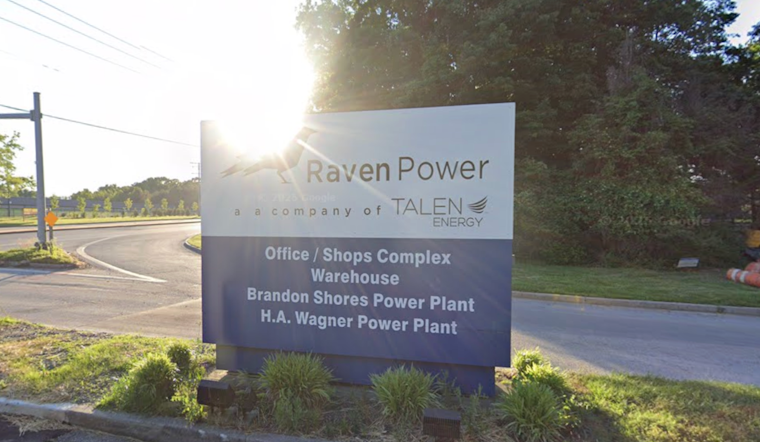
Brandon Shores is a two-unit, 1,273-megawatt coal-fired facility, according to the Maryland Department of Natural Resources. Talen Energy says the plant, originally scheduled to retire in 2025, is continuing to operate under a reliability agreement through May 31, 2029, while transmission upgrades are completed, meaning the proposed homes would be planned next to an active power station for years to come.
Elm Street has described the project as a way to add more diverse housing and a grocery store to a corridor that has already seen substantial residential growth. But the county’s next decision will have to weigh that housing pitch against the wetlands, forest and industrial conditions that make this particular piece of Anne Arundel land unusually contentious.





