

























































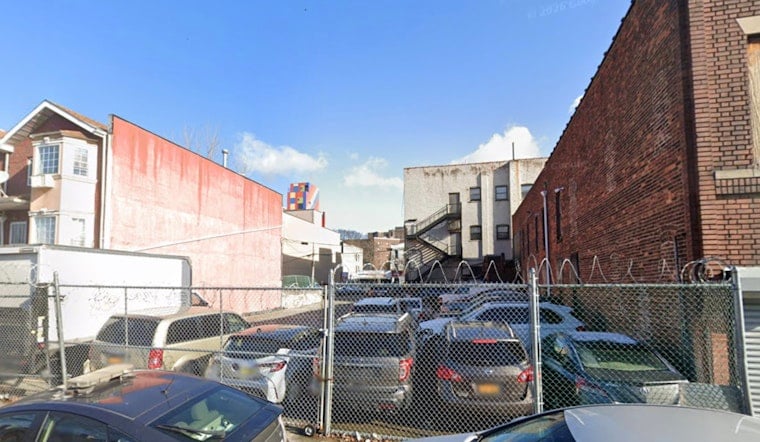
A vacant lot on Chester Street in Brownsville that sat empty for more than a decade is now the site of a proposed nine-story mixed-use building with 99 residential units. The 5,000-square-foot parcel, located between East New York Avenue and Pitkin Avenue, changed hands for $3,070,000 in late March, months before a construction application landed at the city's buildings department this week.
The permit filing, submitted to the Department of Buildings on August 21, was first reported by New York YIMBY, which noted the development is classified as a high-density project. According to PermitRadar, buildings that exceed seven stories are routed through specialized municipal review hubs, reflecting the scale of what's planned for the site. Isaac Rosenberg is listed as the owner behind the applications, and Navkiran Cheema of KMA Designs LLC is named as architect of record, per the filings.
What's Planned for the Concrete-Based Structure
The proposed building would rise 82 feet and include a cellar, according to the permit filing. Plans call for 48,792 square feet of residential space, 11,089 square feet of commercial space, and 7,368 square feet reserved for community facility use, for a total yield of 67,249 square feet. The 99 residences would average roughly 492 square feet each and are most likely intended as rentals, per the report from the same account. Twenty enclosed parking spaces are also included in the design, and because the lot has remained empty, the project is not expected to require demolition permits.
The site sits near the Sutter Avenue subway station, which is served by the L train, giving future residents a transit-adjacent option in a neighborhood where car ownership can be costly. No estimated completion date has been announced for the project.
An Architect Behind a Wave of Brooklyn Filings
Cheema and KMA Designs LLC have been busy across the borough this year, having also filed proposals for 23 units at 720 East 35th Street in East Flatbush and 36 units at 8 Underhill Avenue in Prospect Heights, according to New York YIMBY. Hoodline previously reported on the East 35th Street filing, part of a broader pattern of mid-rise, infill rental proposals the firm has represented this year.
A Neighborhood Long Defined by Subsidized Housing
The Chester Street lot has a documented history of sitting undeveloped. City records from a 2011 Board of Standards and Appeals review show the parcel was previously evaluated for potential charter school development, but it remained vacant for over a decade before this year's sale, according to the agency's filing.
Brownsville and Ocean Hill, designated Brooklyn Community District 16, had a population of 101,832 and a poverty rate of 32.6% as of 2024 estimates, nearly double the citywide average, according to Data USA. The area has historically relied heavily on government-subsidized housing rather than private market development. An August report from the Regional Plan Association found that in Brownsville and neighboring East New York, 75% or more of housing units produced in recent decades have been government-subsidized affordable housing.
That subsidized housing stock includes a substantial public presence: the New York City Housing Authority operates more than 8,576 public housing units across over 20 campuses in the district, housing more than 20,000 residents as of 2024, according to the NYC Department of City Planning. State officials have also pointed to the $1.4 billion Vital Brooklyn Initiative, reporting in June that more than 2,500 affordable homes tied to the program were completed or under construction across Central Brooklyn, per the Office of Governor Kathy Hochul.
Rising Rents Meet a New Private Filing
Against that backdrop, market-rate development pressure has been building. Brownsville's median asking rent reached $3,200 per month in June, a 14.3% increase over three years, according to Realtor.com. The Chester Street proposal arrives as one of several private, transit-adjacent infill filings emerging in a neighborhood where subsidized housing has long dominated new construction.
Under the city's Mandatory Inclusionary Housing program, established during nearby East Brooklyn rezonings, developments in designated zones must permanently set aside at least 25% of residential floor area for lower-income households, according to Ariel Property Advisors. Whether the Chester Street project falls within such a zone, and whether Rosenberg intends to pursue affordability set-asides or tax incentives, remains unclear from the filings themselves. How the building's community facility space will ultimately be used is also not yet specified.


